

LoL tenacity doesn’t get talked about nearly enough, but honestly? It’s one of those stats that can completely flip a teamfight. You know that feeling when Leona, Morgana, and Ashe chain-stun you into the ground while your teammates spam question marks? Yeah, tenacity would’ve helped there.
Let’s dig into everything about tenacity in League of Legends so you can actually move during fights instead of standing there like a practice dummy.
What is LoL tenacity?
LoL tenacity reduces how long crowd control effects last on your champion. Pretty simple concept, it’s basically your “get unstunned faster” stat. Stack enough tenacity and that 2-second stun drops to 1.5 seconds, roots don’t last as long, and you’re not just sitting there watching the enemy team beat you up.
However, here’s where it gets tricky: LoL tenacity doesn’t actually work against every type of crowd control. It’s great for stuns, slows, taunts, fears, silences, blinds, polymorphs, and roots. But if you’re getting knocked up, pulled, grabbed, suppressed, or hit with stasis effects? Your tenacity isn’t doing anything. This is super important to understand before you invest gold into tenacity items. There’s no point buying it if the enemy team is running Malphite, Blitzcrank, and Yasuo who all use knockups and displacement CC.
The math isn’t complicated: 30% LoL tenacity means a 2-second stun only lasts 1.4 seconds. Each percentage point cuts CC duration by that same percentage. As seen in the video, having high tenacity can really make a huge difference in a fight.
It’s important to note that CC duration cannot be reduced below 0.3 seconds, no matter how much tenacity you stack. Additionally, tenacity is capped at 100% since Patch V13.3, meaning you can theoretically become immune to most crowd control effects if you stack enough sources together.

How does tenacity stack in League of Legends?
The thing is… LoL tenacity doesn’t just add up when you stack different sources. It uses multiplicative stacking, which means you hit diminishing returns pretty fast. You can still get some crazy high numbers if you go all-in on it, though.
Let me give you an example, no matter where you are in the current LoL rank distribution. Say you’ve got 30% LoL tenacity from Mercury’s Treads and another 20% from Legend: Tenacity. You’d think that’s 50%, right? Wrong. The actual calculation goes like this: 1 – (0.7 × 0.8) = 44% tenacity. Every time you add another tenacity source, you get a bit less value than the last one, but it’s still worth it.
Champions like Garen (with his Courage W) and Irelia (passive) have built-in tenacity that stacks the same way with your items and runes. If you really commit to stacking everything, you can push past 100% tenacity, which basically makes stuns feel like tiny speed bumps.
LoL tenacity items – Your arsenal against CC
Let’s talk shopping. The most common LoL tenacity item is Mercury’s Treads, which provides 30% tenacity along with 20 magic resistance. These boots are your go-to option when the enemy team has multiple crowd control threats or heavy AP damage. For 1,250 gold, you’re getting both defensive stats and mobility, making them one of the most cost-efficient purchases against CC-heavy compositions.
Beyond boots, here are your main tenacity item options:
| Item | Tenacity | Additional Stats | Best For |
|---|---|---|---|
| Mercury’s Treads | 30% | Magic Resist, Movement Speed | All roles vs CC + AP |
| Sterak’s Gage | 20% | HP, Base AD Bonus | Bruisers and Fighters |
| Wit’s End | 20% | AS, MR, On-Hit Damage | Attack Speed Champions |
| Elixir of Iron | 25% | HP, Path for Allies | Late Game Teamfights |
For bruisers and fighters, Sterak’s Gage provides 20% tenacity in League of Legends along with health and a massive bonus to base attack damage. It also has a shield passive that activates when you take burst damage, making it perfect for top lane champions who dive into the enemy team.
Wit’s End offers another 20% LoL tenacity option, combining it with attack speed, magic resistance, and on-hit magic damage. This item is excellent for attack speed-based champions like Yasuo, Irelia, or ADCs who need both damage and survivability against AP champions.
Elixir of Iron is a consumable that provides 25% tenacity in League of Legends along with bonus health and size. It’s perfect for late-game teamfights when you need that extra edge, and the path it creates for allies makes it especially valuable for engage champions.
Ask yourself, do you need tenacity throughout the entire game, or just in specific windows? Boots give you consistent value from the moment you buy them, while elixirs are reactive tools for clutch moments.
Best tenacity runes for maximum CC reduction
The Precision tree houses your primary LoL tenacity rune: Legend: Tenacity. This rune starts at 5% tenacity and scales up to 20% as you gain stacks from takedowns and minion kills. It’s a snowball rune. Meaning that the better your early game goes, the faster you max it out. The beautiful thing about Legend: Tenacity is that it’s “free” tenacity that doesn’t require item slots, letting you invest your gold into offensive or other defensive stats. Because Precision is often picked for ADC champions, it’s a great way to gain some survivability while also gaining other Precision benefits you need.
Your alternative in the same slot is Legend: Alacrity (attack speed) or Legend: Haste (ability haste). The decision between these runes should be based on enemy team composition. For instance, if they have three or more champions with significant crowd control in their kits, Legend: Tenacity becomes extremely valuable.
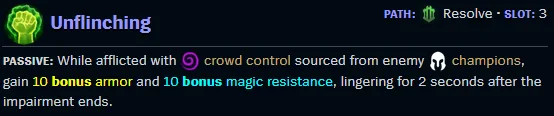
The Resolve tree offers Unflinching, which provides bonus armor and magic resistance when you’re affected by crowd control from enemy champions. Specifically, while you’re slowed or immobilized by enemies, you gain 10 bonus armor and 10 bonus magic resistance, and these defensive stats linger for 2 seconds after the crowd control effect ends. This makes Unflinching particularly valuable against champions who constantly apply slows (like Ashe) or teams with heavy crowd control, as you’ll have those defensive stats active throughout most teamfights.
Credit: League of Legends Wiki
The synergy with Mercury’s Treads and Legend: Tenacity can create some seriously slippery champions who become harder to lock down as fights progress. Support champions like Leona and Thresh can benefit greatly from incorporating this into their Resolve rune.
For maximum LoL tenacity, you can combine both runes by taking Precision as your primary tree and Resolve as secondary (or vice versa). This combination gives you the foundation for extreme tenacity builds that can shrug off most crowd control durations.
When should you build tenacity?
Not every game requires tenacity investment. If the enemy team is running Master Yi, Tryndamere, Katarina, Zed, and Ezreal, you’re facing a composition with minimal hard crowd control. Hence, tenacity won’t help much. Save your gold and rune slots for stats that actually counter their damage patterns.
However, when you’re facing multiple crowd control sources, LoL tenacity becomes exponentially more valuable. A team with Nautilus, Lissandra, Ashe, Amumu, and Leona is going to layer CC on priority targets. In this scenario, the difference between 0% and 50% tenacity is literally the difference between dying instantly and having time to use Flash, heal, or reposition.
Role-specific considerations matter too. ADC players often skip tenacity entirely because they rely on positioning and peel rather than face-tanking crowd control. Moreover, ADC champs and players are not meant to take damage for long where tenacity will play a big role. Meaning, if you get caught, you are most likely dead, even with tenacity. Meanwhile, divers and skirmishers like Yasuo, Sylas, or Aatrox benefit immensely from tenacity because their job requires them to jump into dangerous situations and survive long enough to execute their combos.
Watch for “lockdown” team compositions where enemies have overlapping CC chains. Against these teams, LoL tenacity stats are not luxury, they are survival. Even supports and mages might consider Mercury’s Treads over Sorcerer’s Shoes when the alternative is spending entire teamfights stunned.
LoL tenacity champions with built-in CC reduction
Some champions have tenacity or CC immunity baked directly into their kits, giving them natural advantages in crowd control wars. Understanding which champions have these tools helps you draft smarter and play more effectively.
Garen gets up to 60% tenacity from his Courage (W) ability when activated, making him incredibly difficult to lock down during his spin-to-win rampage. Irelia gains up to 40% tenacity simply from her passive when fully stacked, rewarding her aggressive playstyle in extended fights.
Dr. Mundo might be the king of ignoring crowd control, his Adrenaline Rush (R) provides up to 100% bonus LoL tenacity, essentially making him immune to most CC during his ultimate. Combined with his regeneration, this makes him a nightmare to peel or kite.
Credit: League of Legends Wiki
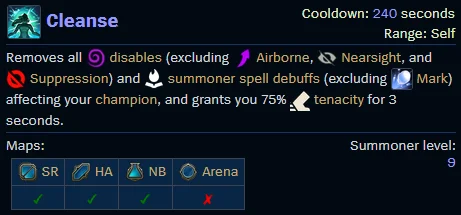
Several ultimates grant temporary CC immunity or suppression-level effects that ignore LoL tenacity altogether. Olaf’s Ragnarok, Master Yi’s ultimate (reduces slow effects), and Gangplank’s Remove Scurvy (W) all provide ways to deal with crowd control without relying on the tenacity stat.
When you’re playing these champions, the decision to build additional tenacity depends on how much value you’re already getting from your kit. Dr. Mundo might still want Mercury’s Treads for the magic resistance even if the tenacity is overkill, while Olaf can often skip it entirely since his ultimate makes him immune to disables.
Common tenacity mistakes to avoid
The biggest mistake is building LoL tenacity against the wrong crowd control types. Remember, LoL tenacity doesn’t reduce knockups, knockbacks, displacements, or suppression. If the enemy team is Yasuo, Malphite, Alistar, Urgot, and Poppy, you’re facing mostly displacement-based CC and tenacity won’t help you much. Learn to identify the difference between crowd control types.
Over-investing in tenacity while neglecting other defensive stats is another trap. If you’re building Mercury’s Treads, Silvermere Dawn, running both tenacity runes, and still getting one-shot by the enemy Zed, you’ve solved the wrong problem. Tenacity only matters if you survive long enough for the reduced CC duration to make a difference.
Don’t forget that LoL tenacity has diminishing returns. Going from 0% to 30% tenacity is huge as you’re reducing CC duration by nearly a third. However, going from 50% to 70% tenacity only reduces CC by an additional 40% of what’s left, giving you less bang for your buck.
Finally, timing matters with active tenacity items. Using Elixir of Iron at the right moment before a major teamfight can give you the edge you need to survive their CC chains and turn the fight in your favor.
Tenacity synergies and team compositions
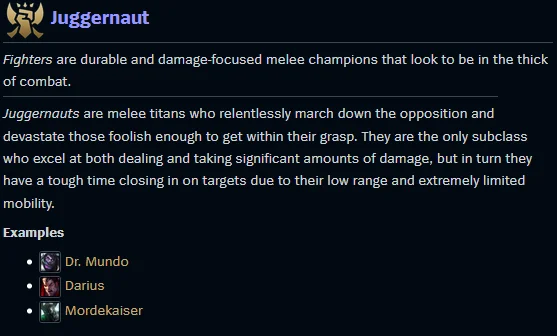
LoL tenacity becomes more valuable when combined with other defensive tools. A champion with high sustain, shields, or damage reduction gets exponentially more value from tenacity because they can actually utilize the extra uptime. This is why bruisers and juggernauts love the stat, as they’re already built to survive in extended fights.
Credit: League of Legends Wiki
Team compositions matter too. If your team has strong peel and disengage, you might not need as much personal tenacity because your teammates will help you escape danger. However, if you’re the primary engage or your team lacks peel, LoL tenacity becomes critical for self-sufficiency.
Consider LoL tenacity when choosing summoner spells as well. The less crowd control you have to deal with (thanks to tenacity), the less often you’ll need to burn Flash defensively. This lets you use Flash more aggressively for plays, creating a snowball effect where your tenacity investment pays dividends in playmaking potential.
Practical tips for maximizing your tenacity value
Check the enemy team composition during loading screen. Count how many hard CC abilities they have, identify who their primary lockdown threats are, and decide if tenacity should be in your build path. This proactive planning beats reactive shopping after you’ve already died twice to their CC chains.
- Track cooldowns on major crowd control abilities
If the enemy Morgana just used her Dark Binding (Q) and you know it has a 10-second cooldown, you can play more aggressively for that window. Your tenacity is most valuable when multiple CC sources can chain together. During cooldown windows, you might not need it at all.
- Communicate with your team about tenacity builds
If your jungler and support are both building Anathema’s Chains and targeting the same enemy, you’re wasting gold on redundant effects. Coordinate who builds what to maximize team-wide efficiency.
- Practice timing the consumables
Practice using consumable items like Elixir of Iron in important teamfights. Timing your elixir usage right before a major objective fight can be the difference between winning and losing.
Frequently Asked Questions about LoL tenacity
Does tenacity work against all crowd control effects?
No, LoL tenacity only reduces the duration of specific CC types. It works on stuns, slows, roots, taunts, fears, silences, blinds, and polymorphs. However, tenacity in League of Legends does not affect knockups, knockbacks, displacements, grabs, suppressions, stasis, or nearsight effects. This is crucial when deciding whether to invest in LoL tenacity. Always check what types of crowd control you’re facing before committing to a tenacity build.
Can you stack tenacity items and runes together?
Yes, but tenacity sources stack multiplicatively, not additively. If you build Mercury’s Treads (30% tenacity) and take Legend: Tenacity (20% when fully stacked), you won’t get 50% total LoL tenacity. Instead, the calculation is 1 – (0.7 × 0.8) = 44% tenacity. Each additional source of tenacity in League of Legends provides diminishing returns, but combining multiple sources can still get you close to the 100% tenacity cap when including champion abilities. The most common combination is Mercury’s Treads plus Legend: Tenacity, which gives you solid CC reduction without over-investing.
Which champions benefit most from building tenacity?
Bruisers, divers, and juggernauts get the most value from tenacity in League of Legends because they need to stay in extended fights to deal damage. Champions like Darius, Sett, Aatrox, Yasuo, and Irelia all benefit from reduced CC duration since their kits require them to be in the middle of fights. Tanks also appreciate LoL tenacity when they’re frontlining for their team. However, ADCs and mages typically prioritize positioning over tenacity, relying on their team’s peel instead. If you’re playing a champion that needs to survive in the enemy’s face to be effective, tenacity becomes a priority stat.
Is it better to buy Mercury’s Treads or keep Berserker’s Greaves with Legend: Tenacity?
This depends entirely on the enemy team composition and your champion. Mercury’s Treads provide immediate 30% LoL tenacity plus 20 magic resistance, making them ideal when facing 2-3+ crowd control threats or heavy AP damage. Legend: Tenacity requires time to stack and doesn’t give you defensive stats. For most situations against CC-heavy teams, Mercury’s Treads are more reliable because you get instant value. However, if you’re snowballing early and can stack Legend: Tenacity quickly while the enemy crowd control isn’t yet threatening, you might keep offensive boots.
Tenacity in League of Legends is a stat that separates good players from great ones because it requires strategic thinking beyond raw damage numbers. It’s not flashy, it doesn’t show up on the scoreboard, but it keeps you in fights longer and gives you more opportunities to outplay opponents.
The key is learning to identify when LoL tenacity solves your problems versus when other stats are more important. Against heavy crowd control comps, tenacity is gold-efficient and game-winning. Against burst or poke compositions with minimal lockdown, you’re better off investing in damage, healing, or pure resistances.
Besides LoL tenacity guides, you can learn more about lethality from LoLNow’s lethality guide, explore the lore of the Runeterra map, and much more.




0 Comments