

Every competitive season, millions of Summoners descend upon the Rift with a singular goal: to see that shiny victory animation and watch their LP bar tick upward. But have you ever stopped to wonder where you actually sit in the grand scheme of things? Are you really “hardstuck,” or are you just statistically average?
The LoL rank distribution is more than just numbers. It’s about understanding the ecosystem of the game. As much as a fresh-faced level 30, so as a grizzled veteran from Season 2, knowing how the ladder is constructed can help you set realistic goals and, perhaps more importantly, save your mental health when a losing streak hits.
In this deep dive, we aren’t just going to list percentages. We are going to analyze the skills that define each bracket, the math that keeps you there, and why the addition of the Emerald tier changed everything.
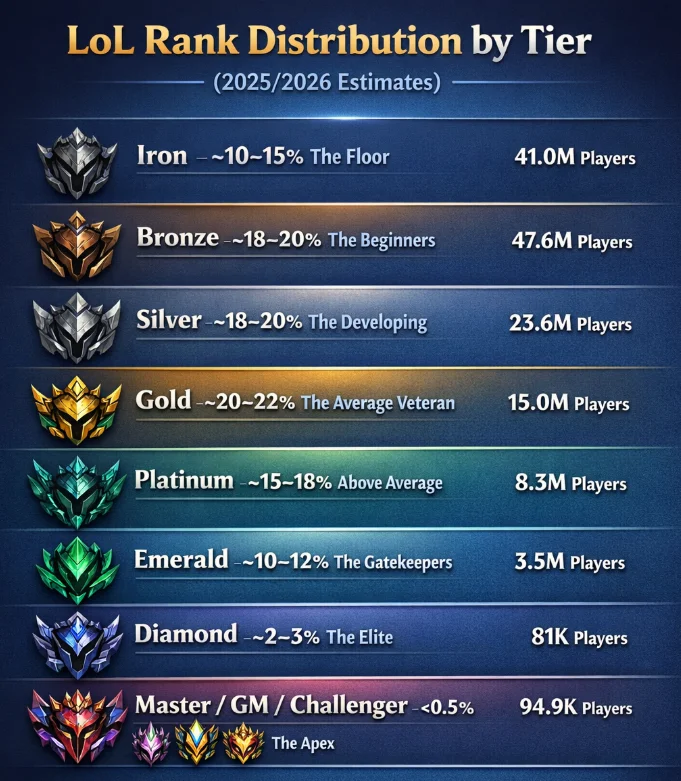
LoL rank distribution by tier (2025/2026 Estimates)
While the exact decimals shift with every patch and season reset, the general architecture of the LoL rank distribution ladder has settled into a predictable rhythm following the massive “Emerald Update” of 2023.
Here is where the player base generally lands. Note: These are estimates based on global averages across major servers like NA, EUW, and KR.
| Rank Tier | Estimated Share of Players | Description | Estimated Player Count |
|---|---|---|---|
| Iron | 10-15% | The floor | 41.038.000 |
| Bronze | 18-20% | The beginners | 47.581.000 |
| Silver | 18-20% | The developing | 23.594.000 |
| Gold | 20-22% | The average veteran | 14.961.000 |
| Platinum | 15-18% | Above average | 8.281.000 |
| Emerald | 10-12% | The gatekeepers | 3.524.000 |
| Diamond | 2-3% | The elite | 81.000 |
| Master, Grandmaster, Challenger | < 0.5% | The apex | 94.900 |
Moreover, if you are currently sitting in Gold IV, congratulations! You are statistically better than roughly 40-50% of the entire player base. If you hit Emerald, you have officially entered the top 15% of players in your region.

From Iron to Challenger – A skill-based analysis of LoL rank distribution
Numbers are fun, but they don’t tell you how to climb the LoL rank distribution ladder. What actually separates a Silver player from a Platinum one? Is it just mechanics? Is it better internet or maybe the money spent on the game? (Spoiler: It’s mostly decision-making).
Let’s break down the rank analysis by skill set.
The foundation – Iron and Bronze
In Iron and Bronze, the game is almost entirely defined by a lack of fundamentals. This isn’t an insult; it’s a reality of the learning curve. Players here often treat League like a fighting game rather than a strategy game. Most of the time, the vibe of these ranks is: “I’m just here to fight.”
- The skill gap: The primary struggle here is camera control and mouse accuracy. Iron players often play with a locked camera and click their abilities rather than using quick-cast.
- The fix: If you are here, stop worrying about “counter-picking” or meta builds. Focus entirely on your own champion. Learn to last-hit minions without looking at your keyboard.
- Key takeaway: Games here drag on for 40+ minutes because players do not know how to close out a game after winning a fight.
In Iron and Bronze you can find players that spent plenty of time in-game without actually spending time to improve their fundamentals. Due to this approach, many of these long-term players “stuck” here will find a way to blame anything on why they do not climb.
The plateau – Silver and Gold
Queue in the “I know what I’m doing, but my team sucks.” discussions.
This is the most populated section of the LoL rank distribution. Players in Silver and Gold have decent mechanics. They know their champion combos, they ward bushes, and they watch esports. The problem? Inconsistency.
Farming is one of the crucial aspects of snowballing and making sure you are as strong as you can be. Many players in Silver (especially) and Gold seem to neglect farming after a certain point. As you can see in the video, farming an entire wave of minions over the full minute (two waves) will grant you more gold than a single kill.
Good farming also helps you with tempo and dead-time. In addition, focusing on farming also helps with pushing waves to secure objectives.
Farming inconsistency is just one of many flaws Silver and Gold players tend to fall victim to, and this is something that needs to be practiced.
- The skill gap: A Gold player can look like a Diamond player for 10 minutes, then make a mistake that throws the entire game. The difference between Silver and Gold often comes down to object permanence. Silver players chase kills into the unwarded jungle. Gold players might hesitate because they know the enemy Jungler is missing.
- The fix: To escape the average, you must learn Wave Management. Understanding when to freeze a lane and when to shove it is the single biggest delineator between Gold and Platinum. The last thing you want is to push a wave into the enemy turret and a Nunu rolling into you from the river.
The filter – Platinum and Emerald
Many players below this rank have a feeling that they have it worse. However, those who make it through the LoL rank distribution and land here will be joined by the “Everyone has an ego, and everyone is tilted.” crowd.

Welcome to the thunderdome. The introduction of the Emerald rank created a massive holding pen for players in the League of Legends rank distribution who are mechanically gifted but mentally fragile. This is where the game becomes significantly faster.
- The Skill Gap: In Platinum and Emerald, players punish mistakes instantly. If you step forward to hit a minion when your cooldowns are down, you will lose half your health bar.
- The Emerald Trap: Emerald is unique because it contains a mix of decaying Diamond players and climbing Platinum players. The skill disparity within a single match here can be wild. The defining skill of this bracket is Tempo. It’s not just about getting kills; it’s about what you do after the kill. Do you recall? Do you take Dragon? Do you push a tower?
- The Fix: Mental resilience. This bracket has the highest rate of “giving up” early. Being the player who doesn’t type/chat and focuses on win conditions is a legitimate climbing strategy here.
The elite – Diamond and above
This is where players switch up from “I’m just here to have fun” mentality to “League of Legends is a job.” thinking.
Once you break into Diamond, you are in the top ~3% of the world. The rank analysis here shifts from “learning the game” to “mastering the details.”
- The Skill Gap: Matchups are played to near-perfection. A Diamond top-laner knows exactly how much damage Riven does at Level 3 with a Long Sword vs. a Doran’s Blade.
- Macro Mastery: The Apex tiers (Master+) play a different game entirely. It is less about solo kills and more about map pressure. Supports roam at specific timers, Junglers track the enemy camps blindly, and waves are manipulated to crash exactly when an objective spawns.
Why the Bell Curve matters
Before we start judging players for being in Bronze (we’ve all been there), we need to understand why the ladder looks the way it does. Riot Games engineers the ranked system to follow a modified Normal Distribution, often called a Bell Curve.
In a perfectly balanced competitive game, the vast majority of players should be average. That sounds harsh, but in statistical terms, “average” is the peak of the bell. Historically, this was Silver and Gold. If the system worked perfectly, 50% of the player base would sit comfortably in the middle, with the population tapering off as you go lower into Iron or higher into Diamond.
Granted, learning the games mechanics and hidden passives can help you play better, but there are much more factors to take into consideration when climbing. In this instance, being average does not equate to being bad. It just means that, in the vast pool of players, it’s really hard to “stand out” without proper etiquette.
However, League is not just a math problem; it’s a psychological one. Riot wants you to feel a sense of progression. This is why the visual rank you see (e.g., Gold II) is distinct from your hidden Matchmaking Rating (MMR). The system is designed to let you climb visually if you put in the grind, even if your statistical skill level remains relatively stable.
The math behind the climb & why you are “hardstuck”
Your visible rank (e.g., Silver I) is just a mask. The real number is your MMR (Matchmaking Rating).
- Positive LP Gains: If your MMR is higher than your rank, the game gives you more LP to push you up to where you belong.
- Negative LP Gains: If your MMR is lower than your rank (perhaps you went on a lucky win streak), the game clamps your LP gains to pull you back down.
The “Net Zero” eco-system of LoL rank distribution
The LoL rank distribution ladder is largely a zero-sum game. For you to climb, someone else must fall. This is why climbing gets exponentially harder the higher you go. In Iron, you are competing against people who might be playing on a trackpad. In Diamond, you are competing against people who have played the game for 10 years and review their own replays.
The “Clamping” Phenomenon
As you approach the top of a tier (e.g., Gold I, Emerald I), you might notice your gains slow down in the LoL rank distribution. This is Clamping. The system is double-checking: “Are you sure you belong in the next tier?” It requires you to maintain a higher win rate over a sustained period to break through the ceiling.
For a deeper technical look at how MMR works, you can read Riot’s official breakdown on MMR and Rank, which explains the relationship between your hidden rating and your visible LP.
How to move up the LoL rank distribution ladder
Everyone wants to improve. However, improving often means expanding your existing knowledge and letting go of your ego. No matter where you belong to, there should always be room for improvements.
With the majority of player base sitting at the middle of the LoL rank distribution (which is expected), it’s important to understand ways to improve. In this YouTube video, the 10 rules that are mentioned are a great way to test whether or not you are doing things correctly. From always aiming to get more gold, through making sure you make the most of your dead time in game, to avoiding forced situations and fights, many players from the mid-tier of ranks can improve their game.
How Emerald changed the LoL rank distribution system
In 2023, Riot Games made a historic change to the LoL rank distribution by adding the Emerald tier. Before this, the ladder was incredibly bottom-heavy. Nearly 60% of the player base was cramped into Bronze and Silver.
This “clumping” made matchmaking difficult because the skill difference between a “Low Silver” and a “High Silver” in the LoL rank distribution was massive, yet they had the same badge.
By adding Emerald between Platinum and Diamond, Riot aimed to flatten the curve.
- Gold became the new Silver: The “average” player in the LoL rank distribution was pushed up from Silver to Gold.
- Platinum became more accessible: Many players who were hardstuck Gold for years finally hit Platinum.
- Diamond became exclusive again: Before Emerald, Diamond IV was becoming overpopulated. Emerald acted as a buffer, ensuring that Diamond remained a truly elite tier.
This shift was controversial, but statistically, it created a healthier LoL rank distribution where players were spread more evenly across the middle tiers, leading to (theoretically) fairer matches.

Glossary of Ranked Terms
Going up the LoL rank distribution does not mean only winning games. While yes, winning game will get you your rank, you will need to know how to “behave” in that rank. This means learning more about the game each time you progress.
Moreover, picking the right ADC for the match or knowing which support is META right now can help you plenty on your road.

If you want to sound like a pro (or just understand what your teammates are yelling about), here is a quick glossary of terms related to rank analysis.
- MMR (Matchmaking Rating): A hidden numerical value that determines who you play against. You cannot see this number, but it is the most important stat on your account.
- LP (League Points): The visible points you gain or lose after a ranked match. 100 LP usually triggers a promotion.
- Elo Hell: A community term describing a LoL rank distribution place where a player feels they are better than their teammates but cannot climb due to “bad luck.” Statistically, this doesn’t exist, but emotionally, it is very real.
- Smurf: A high-ranking player of the LoL rank distribution playing on a low-ranking account. This disrupts the LoL rank distribution by placing a high-skill player in a low-skill bracket.
- Apex Tiers: The collective name for Master, Grandmaster, and Challenger. These ranks do not have divisions (like IV, III, II, I) and strictly run on total LP.
- Decay: A mechanic in Diamond and above where you lose LP automatically if you do not play a game for a certain number of days. This prevents players from reaching a high rank and “sitting” on it all season.
- Inting: Short for “Intentional Feeding,” but now used colloquially to mean playing poorly.
- Macro: Strategic gameplay decisions (rotations, objectives, map awareness).
- Micro: Mechanical gameplay decisions (aiming skill shots, dodging, movement).
Frequently Asked Questions about LoL rank distribution
Is “Losers Queue” actually real?
Technically? No. Emotionally? Absolutely. Riot Games has confirmed multiple times that there is no hidden system in the LoL rank distribution system forcing you to lose to keep you addicted. However, the system does try to keep you at a 50% win rate. If you go on a massive winning streak, your MMR spikes, and you are suddenly matched against significantly better players (or placed with lower-skill teammates to balance the team’s total MMR). This helps keep the LoL rank distribution system balanced.
Why do I gain +18 LP but lose -28 LP?
This is the math of the LoL rank distribution ladder shouting at you. It means your Visible Rank is currently higher than your Hidden MMR. Basically, the system thinks you are a Silver II player, but you are sitting in Gold IV. To “correct” this error, the game clamps your gains and amplifies your losses until your rank drops to match your actual skill rating. The only fix is to win consistently against those lower-rated opponents to prove the system wrong.
What is the true “average” in the LoL rank distribution system?
If you are in Gold IV or Gold III on the LoL rank distribution ladder, you are statistically the average League of Legends player. Before the Emerald update, the average was Silver II. Today, roughly 50% of the entire player base sits between Bronze I and Gold III. If you manage to hit Platinum IV, you are effectively “above average,” sitting comfortably in the top 30-35% of the server.
What percentage of players actually reach Challenger?
Challenger is reserved for the top 0.013% to 0.018% of players, depending on the server size. To put that in perspective, in a stadium of 20,000 League players, only three or four of them would be Challenger. Even hitting Master tier puts you in the top 0.5%, making you statistically better than 99.5% of the people who launch the client.
In the end, understand that the LoL rank distribution is a ladder, not a wall. Whether you are fighting to get out of Iron or pushing for that Master border, the math remains the same: consistency beats intensity.
The players who climb the highest are not always the ones with the flashiest plays; they are the ones who tilt the least, farm the best, and understand that one loss does not define a season. Even using additional tools to improve your knowledge can be of great use. So, keep practicing and keep improving and you will get there.




0 Comments