

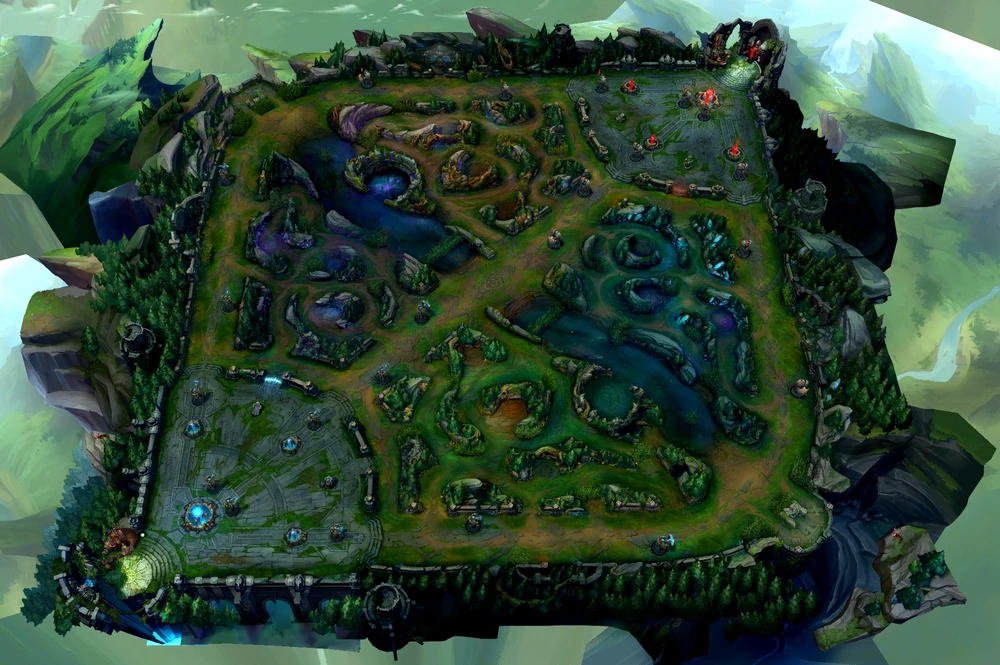
In the original 2009 lore, the Runeterra map was a literal battlefield known as the Fields of Justice. It depicts powerful mages known as “Summoners” (the players) which control champions like puppets to resolve political disputes between city-states. One of the main goals with this story was that it was preventing the world from being destroyed by unchecked magical warfare.
Today, the whole “Summoner” concept is left behind to give champions more agency in their own stories. However, the geography of the world still remains rooted in those magical foundations.
For the modern player, the Runeterra map should represent an evolution of the story you are witnessing. Most importantly, knowing this can help you understand why Arcane takes place on a bridge or even why the map terrain shifts during the Elemental Drake events.
From the Fields of Justice to a living world
Before it was a sprawling continent, the LoL map was defined by the Summoner’s Rift, a place of concentrated magical energy located in a remote forest. Historically, this was where the Institute of War held its sanctioned matches. The lore once dictated that every champion you played was “summoned” to this specific location by a player character to fight on behalf of a faction.
Now, Runeterra map borders transcend their predecessor. You will find major continents like Valoran (Freljord, Noxus, Demacia), Shurima, the archipelago of Ionia, as well as smaller fractions in the sea. The most fun part? All of them are rich in lore, culture, and character.
The Cataclysmic Rune Wars
The historical foundation of the Runeterra map is built upon the scorched earth of the Rune Wars. Rune Wars was a global disaster in which “World Runes” were deployed as weapons of mass destruction – artifacts so volatile that they physically reshaped the world the LoL map.
The scars of this era explain why certain regions are barren wastelands and why nations like Demacia are so terrified of magical influence.

Defining the regions of the Runeterra map
The appeal of the Runeterra map goes beyond pretty fantasy art; it effectively serves as the design document for League’s various champion classes. The geography of the world dictates the ‘kit’ of its inhabitants. Every region operates on a specific philosophy of survival, which translates directly into gameplay.
When you break down the regional identities, the design philosophy behind champion kits becomes clear. For instance, the massive gameplay difference between Garen and Darius makes perfect sense once you look at their origins.
If we look at Demacia, we can see that their core value is endurance. On the flip side, Noxus is all about efficiency of execution. Hence, Demacians focus on surviving a hundred hits, while Noxians is built to make the final one count.
Noxus – The Immortal Bastion
Noxus are embodiment of aggression of the Runeterra map centered around the Immortal Bastion. The Immortal Bastion is reportedly holding secrets to the afterlife. The people of Noxus value strength above all else. Unlike the hereditary monarchies of other regions, Noxus is a meritocracy: if you are strong, you belong, regardless of your origin.
This aggressive expansionism is why the Noxian borders on the LoL map are always in flux, and it explains why their roster feels so chaotic. Noxus doesn’t just conquer land; they weaponize the assets of the cultures they absorb. This is the only region where a zombie warrior like Sion can serve alongside a blood mage like Vladimir. Their diversity isn’t accidental tho. It is a strategic collection of the deadliest tools from across the continent.
The empire is no longer ruled by a single tyrant but by the Trifarix, a council representing the three principles of strength:
- Vision: Represented by Swain.
- Might: Represented by Darius.
- Guile: Represented by the Faceless (often associated with LeBlanc and the Black Rose).
In-game, the Noxian philosophy translates into ruthless aggression, execution-based mechanics (like Darius’ ultimate), and explosive damage output. The goal for a Noxian champion is rarely to stall. They want to overwhelm. This high-risk, high-reward playstyle is perfectly embodied by the region’s core icons like Darius (The Hand of Noxus), Katarina (The Sinister Blade), and Swain (The Noxian Grand General).
Demacia – The Petricite Protectorate
On the western edge of the Runeterra map, Demacia stands as a bastion of nullification. The entire kingdom is built upon Petricite, a white, fossilized wood capable of absorbing magic. This isn’t just architectural flair; it is a survival mechanism born from the trauma of the Rune Wars.
Because their society views magic as a threat to be suppressed, Demacian champions are designed to be the ultimate counters to mages, relying on raw physical durability and silence mechanics to dominate the battlefield.
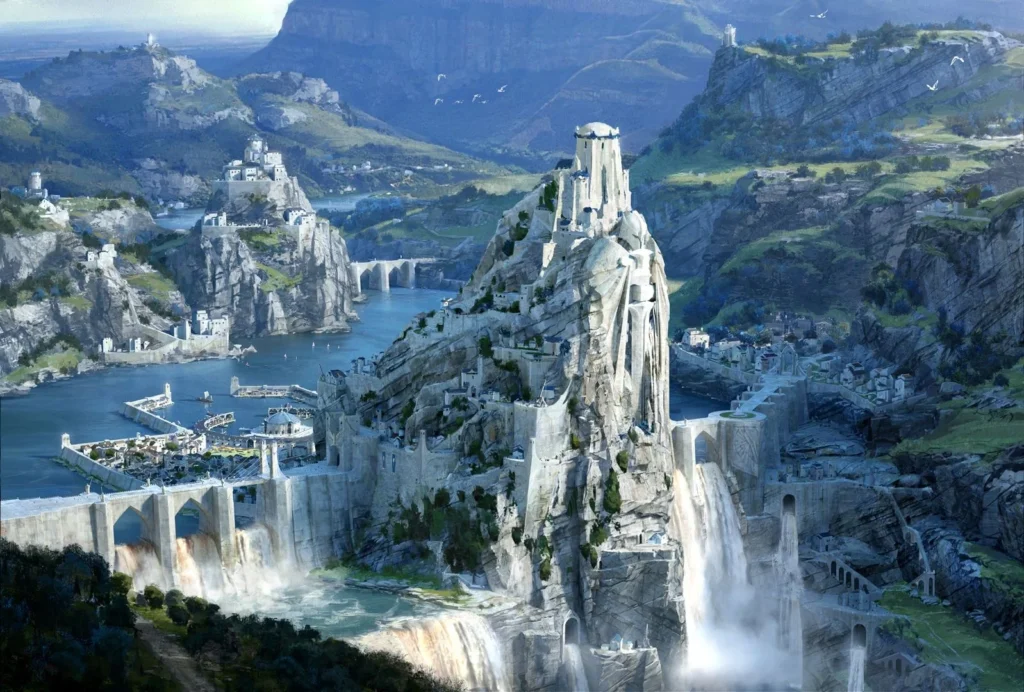
This fear has recently torn the region apart. The “Mage Rebellion,” led by the escaped prisoner Sylas, has forced Demacia to confront its hypocrisy. Champions like Lux, who wields light magic while serving a crown that bans it, are caught in the middle of this civil war.
The in-game identity of Demacia focuses heavily on anti-magic mechanics, high durability, and “fair fight” duelists who excel in structured combat. Their kits are designed to punish those who rely on flashy magic or trickery, reflecting a culture that values martial honor above all. Perfect examples include Garen (The Might of Demacia), Lux (The Lady of Luminosity), and Sylas (The Unshackled).
The Freljord – The Frozen North
The Freljord is the brutal, icy expanse at the top of the Runeterra map, a land where only the strongest survive. It is the home of the Iceborn, humans with an ancestral resistance to the cold and the ability to wield True Ice weapons. The region is currently locked in a three-way civil war for control:
- The Frostguard: Led by Lissandra, who guards the dark secrets of the deep.
- The Avarosans: Led by Ashe, who seeks to unite the tribes peacefully.
- The Winter’s Claw: Led by Sejuani, who believes peace is death and strength comes from war.
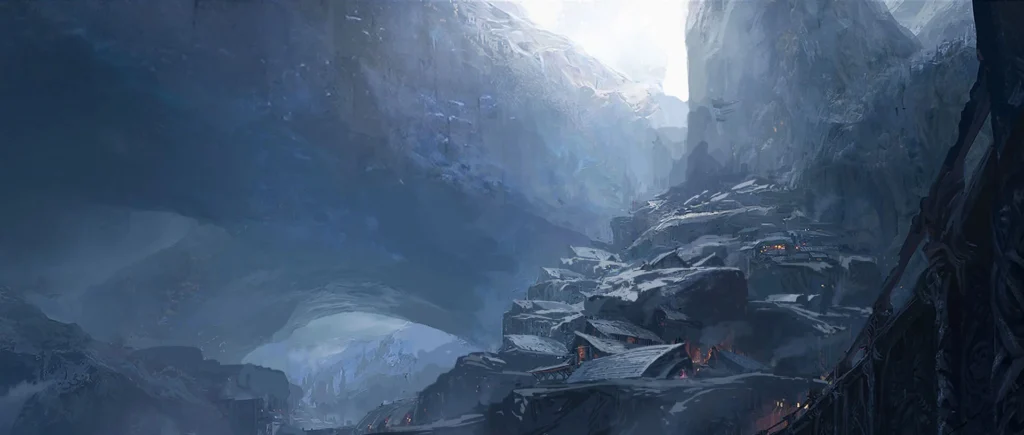
his region is vital to players because it is the actual setting of the ARAM (All Random All Mid) game mode. The “Howling Abyss” bridge sits over a rift where Lissandra keeps the “Watchers” -cosmic horrors from the Void, frozen in ice. If that ice ever melts, the Runeterra map would be consumed.
Crowd Control (stuns/slows), tankiness, and engagement tools are what makes Freljordians stand out from the rest. Prime examples of this would be Braum (The Heart of the Freljord), Volibear (The Relentless Storm), and Ashe (The Frost Archer).
Shurima – The Resurrected Empire
The southern continent of the Runeterra map is dominated by the Shuriman desert. Thousands of years ago, Shurima was the center of the world, utilizing the Sun Disc to transform their best warriors into god-like “Ascended” beings. The empire collapsed in an instant when the magus Xerath betrayed Emperor Azir during his Ascension ritual, leaving the land a ruin of sand and ghosts.
In current lore, Azir has been resurrected and the Sun Disc has risen once more. Shurima is now a land in conflict between the newly returned Emperor, the nomadic tribes (like Taliyah’s), and the monstrous Voidborn encroachments from the south.
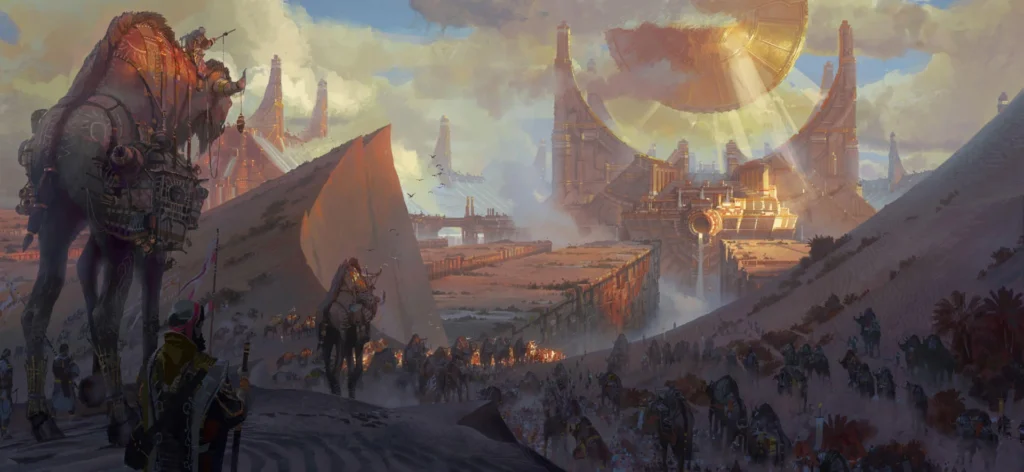
Most Shuriman champions are recognizable by their late-game scaling (reflecting the “Ascension” to godhood) and zone control. Azir (The Emperor of the Sands), Nasus (The Curator of the Sands), and Taliyah (The Stoneweaver) are some of the most popular champions from this region.
Ionia – The Spirit Realm’s Reflection
Ionia, known as the First Lands, is an archipelago on the eastern edge of the Runeterra map. Unlike the technological Piltover or militaristic Noxus, Ionia is defined by its connection to the Spirit Realm. Here, the magic is so dense that the land itself is alive; trees breathe, and the environment shifts to match the emotions of its inhabitants.
The Noxian invasion did more than just scar the land; it fundamentally shifted Ionia’s identity from passive harmony to active defense. This conflict split the region between spiritual traditionalists like Karma and the militarized resistance led by Irelia.
In-game, this connection to the fluid ‘Spirit Realm’ translates into the most mechanic-heavy champions on the roster. The high mobility and ‘outplay’ potential seen in champions like Ahri, Yasuo, and Irelia are direct reflections of a land that refuses to be pinned down.
Piltover and Zaun – The Economic Isthmus
Located at the narrowest point between the continents of Valoran and Shurima, Piltover and Zaun represent the most strategically significant location on the Runeterra map. Originally a solid landmass, this area was severed by a massive, man-made disaster involving chem-tech explosives. This event created the Sun Gates, a canal that connects the eastern and western oceans.
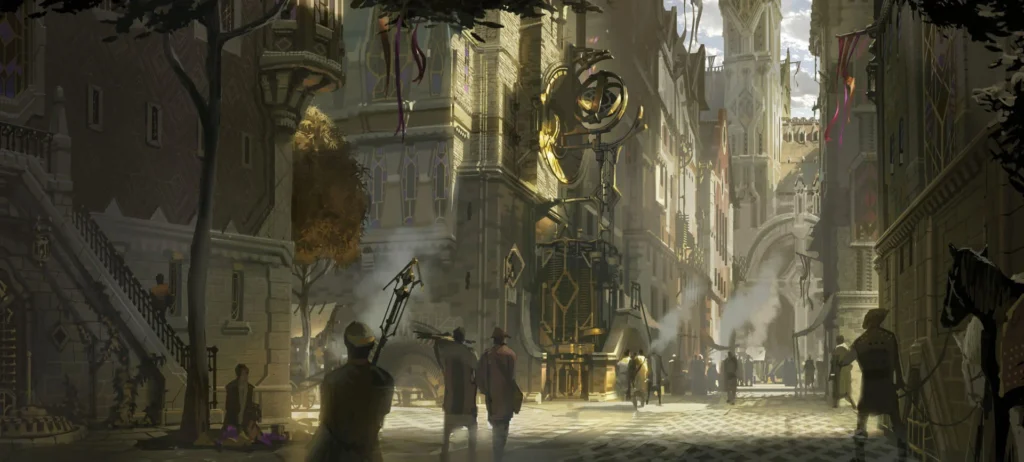
Why this matters? Control of the Sun Gates means control over global trade. This monopoly has made Piltover the wealthiest city on the LoL map, funding their “City of Progress” on the cliffs above. Meanwhile, the industrial runoff and toxic fumes settled in the canyons below, creating the desperate, survivalist culture of Zaun (the Undercity).
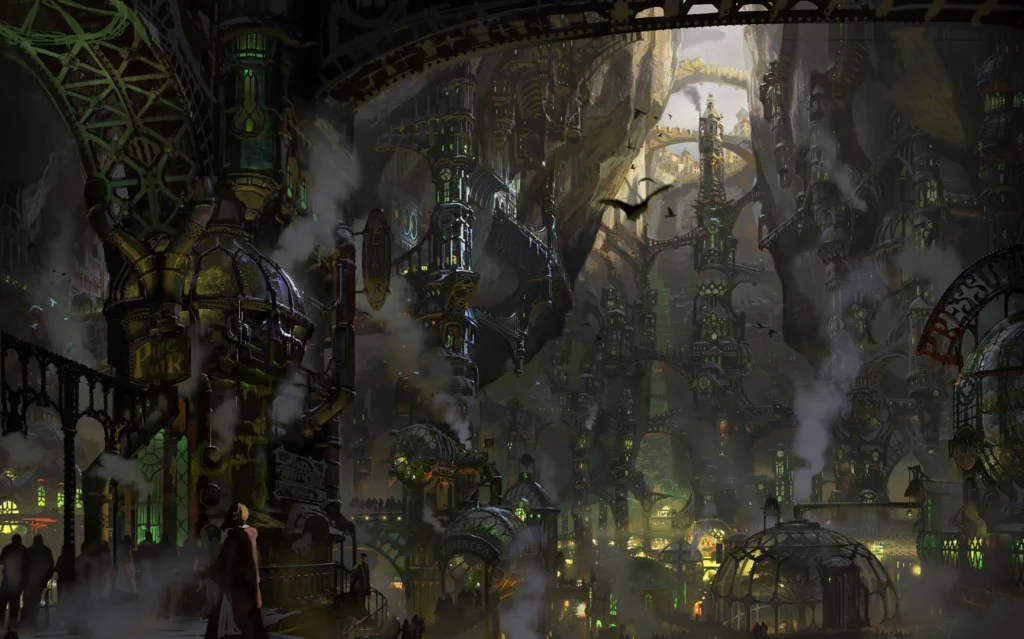
This “Upper” and “Lower” dynamic is famously explored in the animated series Arcane, but it also dictates the technology found in the game:
- Piltover: The source of Hextech – clean, magic-based technology (e.g., Hextech Rocketbelt).
- Zaun: The source of Chemtech – volatile, chemical-based experimentation (e.g., Chemtech Putrifier).
- In-Game Identity: Gadgets, guns, and high-tech weaponry.
- Key Champions: Caitlyn (The Sheriff of Piltover), Vi (The Piltover Enforcer), Jinx (The Loose Cannon), and Ekko (The Boy Who Shattered Time).
The Serpent Delta and the Guardian’s Sea
The southeast corner of the Runeterra map is dominated by the Guardian’s Sea, a treacherous expanse where the natural world, the criminal underworld, and the supernatural converge.
The Serpent Delta acts as a massive “buffer zone” where the wild magic of the Shuriman jungles (Ixtal) meets the salt of the ocean. It is a labyrinth of shifting waterways that makes navigation nearly impossible for outsiders.
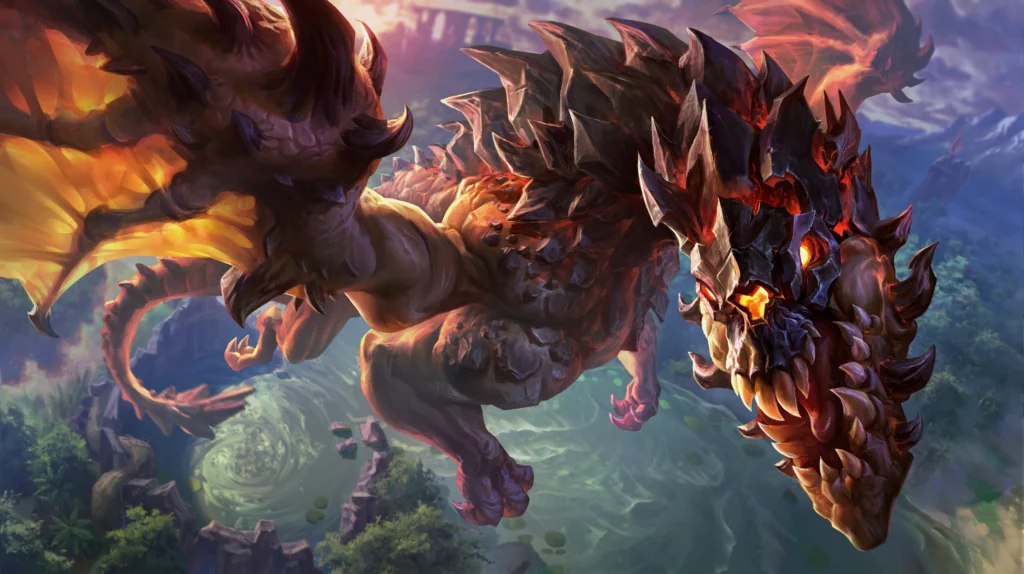
The Elemental Drakes (Mountain, Ocean, Infernal, Cloud, Hextech) are direct exports from the Ixtal jungles surrounding the Delta. When the map physically transforms (e.g., the Ocean Rift growing more bushes), you are essentially seeing the “Wild Magic” of the Serpent Delta overtaking the arena.
- Geographic Barrier: The Guardian’s Sea is the primary body of water separating the mainland from Ionia. Control over these waters is what allowed Noxus to launch its naval invasion of Ionia, a campaign that changed the trajectory of the First Lands forever.
- Hidden Empires: This delta hides the borders of Ixtal, where champions like Qiyana and Nidalee use elemental magic to keep their civilization invisible to the rest of the world.
Bilgewater – The Lawless Port
Sitting in the Serpent Isles within the Guardian’s Sea, Bilgewater is a port city built from the literal wreckage of ships from all over the Runeterra map. It is a meritocracy of greed where monster hunters, pirates, and smugglers settle their debts.
Following the fall of the reaver king Gangplank, the city is in a state of violent flux, with Miss Fortune attempting to impose a semblance of order.
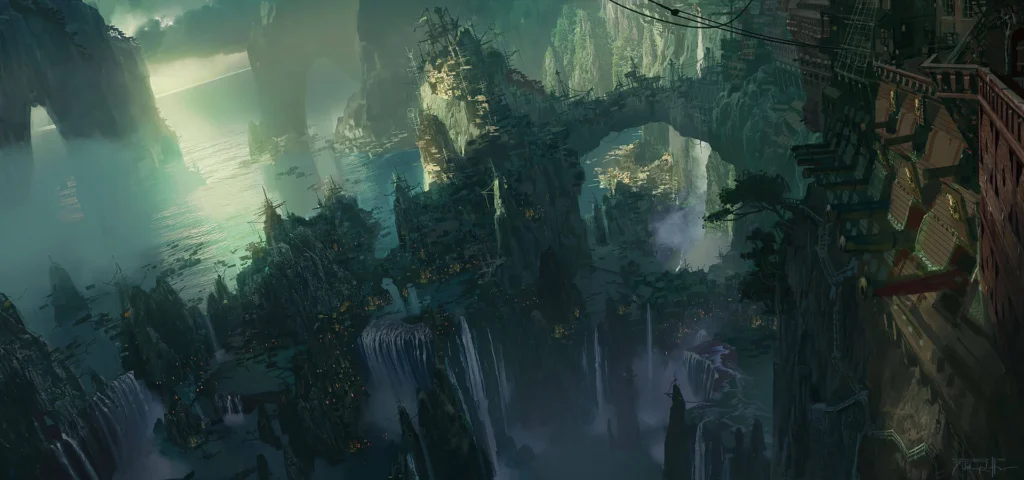
Bilgewater’s influence is seen in the “neutral” gold mechanics. The Scuttle Crab and the gold-rich Bounties on champions reflect the “high-stakes, high-reward” philosophy of the port city.
- Role in Map Design: Bilgewater represents the “Frontier” of the map, a place where the rules of the major nations don’t apply.
- Key Champions: Miss Fortune, Gangplank, Pyke, Illaoi, and Nautilus.
The Shadow Isles – The Source of the Harrowing
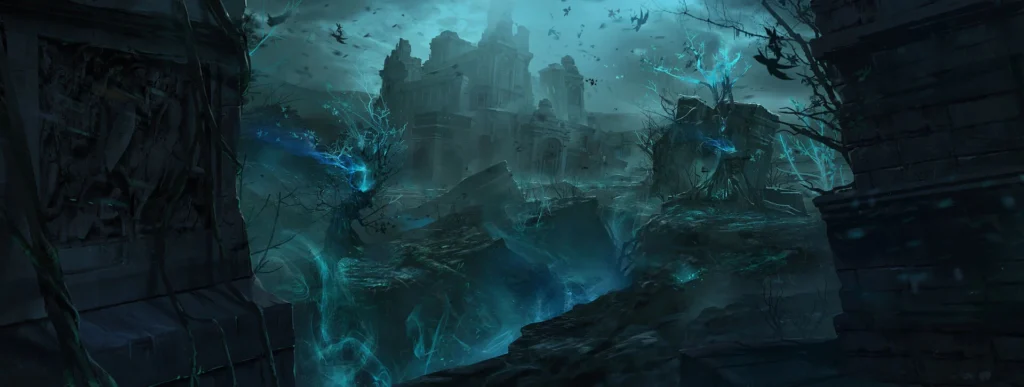
East of Bilgewater lies the most cursed location on the Runeterra map. Once the beautiful Blessed Isles, this archipelago was corrupted by the Ruination, a magical cataclysm that merged the material and spirit realms into a nightmare of undeath.
While Viego was eventually defeated during the global Sentinels of Light event, the Shadow Isles remain a permanent scar on the map, continuing to leak spirits and darkness into the surrounding seas.
Vision mechanics and items like Control Wards and champion abilities that “reveal” the mist (like Kalista’s Sentinel or Maokai’s Saplings) are direct gameplay translations of survival in the Shadow Isles.
- The Black Mist: This Mist acts like a predatory weather system, periodically flowing out across the Guardian’s Sea to strike Bilgewater and beyond in an event known as the Harrowing.
- Key Champions: Viego (The Ruined King), Thresh, Hecarim, Kalista, and Gwen.
Frequently Asked Questions
Are the Summoners still canon on the Runeterra map?
In the “rebooted” lore, the Summoners and the Institute of War are no longer considered part of the main story. Instead, the champions are independent actors with their own goals. However, the term “Summoner” is still used to refer to players in a meta-context.
What is the largest city on the LoL map?
Noxus Prime, the capital of the Noxian Empire, is considered the most populous city due to its inclusive nature and massive land area.
Where do Yordles live on the Runeterra map?
Yordles live in Bandle City, which exists in the Spirit Realm. It doesn’t have a fixed location on the physical map; instead, portals appear in various “Bandlewoods” across the world.
Why is the Shadow Isles region so important?
The Shadow Isles are the source of the Ruination, a global threat that can affect any part of the Runeterra map. It is a recurring narrative theme that allows Riot to host world-wide events.
The Runeterra map has come a long way from being a static background for the Fields of Justice. What started as a simple justification for a 5v5 MOBA has blossomed into one of the most detailed fantasy worlds in gaming, rivaling the depth of classic RPGs.
Whether you are tracking the expansion of the Noxian empire or climbing the peaks of Mount Targon, the LoL map provides the context that keeps the game fresh. While knowing the history of Shurima won’t directly improve your MMR, it changes the texture of the match. Suddenly, a mid-lane matchup between Azir and Xerath isn’t just a poke-battle; it’s the climax of a civil war that wiped out a civilization.
If you find a specific region to speak to you and find champions that are from that region, checking out our Tier Lists for each role can help you understand how strong they are right now.




0 Comments