

So, you have hit Level 30. You have mastered the art of last-hitting (mostly), you know where the Baron pit is, and you are ready to stop playing for fun and start playing for glory. Welcome to the ladder.
If you are looking for a detailed League of Legends ranks guide on the web, you are in the right place. The ranked ecosystem in League is a complex beast that changes its stripes frequently. If you are reading this in 2026, you aren’t just dealing with the classic Iron-to-Challenger climb. You are navigating a landscape of three distinct splits per year, intricate demotion shields, and a matchmaking system that is smarter and more punishing than ever before.
This League of Legends ranks guide is your definitive roadmap to the ladder. Whether you are hardstuck Emerald or a fresh placement contender, we are going to break down exactly how the machine works and how you can make it work for you.
The tier hierarchy: Where do you fit?
Before we dive into the complex math of LP gains later in this League of Legends ranks guide, let us establish the battlefield. The ladder is divided into ten distinct tiers. Most of the player base resides in the “metal” ranks (Silver and Gold), while the “Apex” tiers are reserved for the top fraction of a percent.
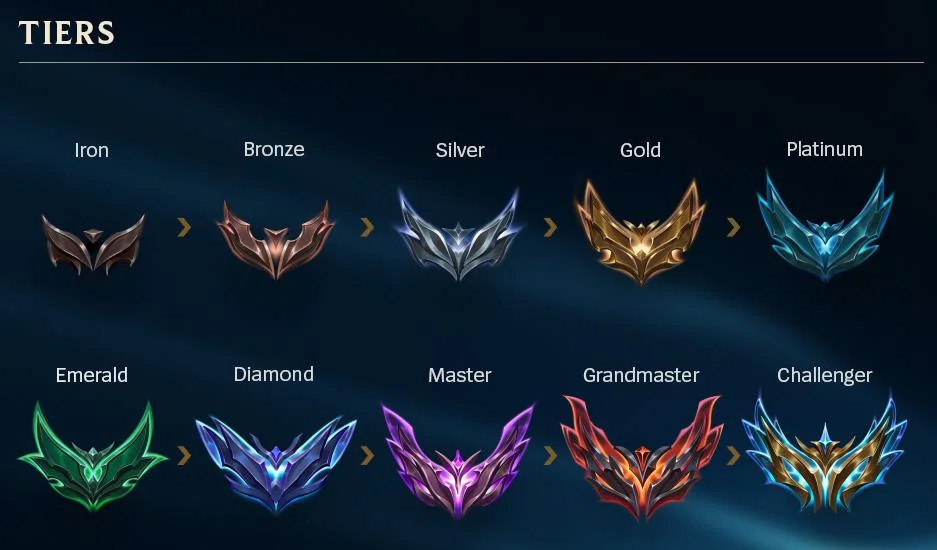
Here is the breakdown of the ranks in LoL from lowest to highest:
- Iron: The starting ground. This is where you learn the very basics of camera control and objectives.
- Bronze: Players here know the champions but struggle with map awareness.
- Silver: The most populated tier. Mechanics are decent, but decision-making is inconsistent.
- Gold: The historical standard for “good.” Reaching Gold usually secures you the Victorious skin.
- Platinum: Above average. Players here specialize in specific roles and champions.
- Emerald: The modern gatekeeper tier. Added to smooth out the skill curve, this is a mix of veteran Platinum players and aspiring Diamonds. It is notoriously volatile.
- Diamond: The beginning of high Elo. You are now in the top 2% to 3% of the player base.
- Master: Semi-professional level.
- Grandmaster: The waiting room for the elite.
- Challenger: The best of the best. Pro players and streamers live here.
Each tier from Iron to Diamond is divided into four divisions (IV being the lowest, I being the highest). As any League of Legends ranks guide will tell you, climbing requires consistency. To climb from Silver IV to Silver III, you need 100 League Points (LP). Once you hit 100 LP in Division I, you instantly promote to the next tier (e.g., Silver I to Gold IV).
A lot of players from the community have their inside jokes and quirks about each rank, as you can see in this video. However, many of those jokes are an exaggeration of the actual skill for each rank. While they are humorous, they are not designed to insult or degrade players, but just make a fun spin to the situation.
Note: Promotional series between tiers are a thing of the past. You no longer need to win a “best of 5” to prove you deserve Gold. You simply cross the LP threshold and the game promotes you instantly.

The two ranked queues: Solo/Duo vs. Flex
A critical distinction to make is that League actually has two separate ranked ladders. They function independently, meaning you can be Diamond in one and Silver in the other.
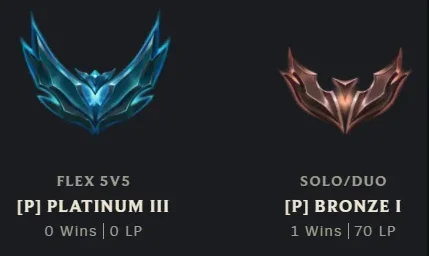
Credit: Reddit
On your League journey, you will find players who spend their League time playing only one of the two, while there are others who balance them. It all really depends on whether or not you have a group you play with, or if you are a lone-wolf.
Ranked Solo/Duo
This is the premier queue detailed in every League of Legends ranks guide. It is where individual skill is measured. As the name suggests, you can queue up alone or with one friend (a duo). However, there are restrictions.
- Iron to Diamond: You can duo with friends within one tier of your own.
- Master and Above: The “Duo” option is disabled. Once you reach the Apex tiers, you must play alone. This ensures the top of the ladder is purely based on individual merit and not boosted by a partner.
Ranked Flex
This queue allows groups of 1, 2, 3, or 5 players. Groups of 4 are disabled to prevent the solo player from getting bullied by the premade group. Flex is often treated as a more casual “practice mode” by the community, but it is excellent for organized team play and practicing Clash strategies.
A League of Legends ranks guide to deciphering LP: The math behind the madness
“Why did I only gain +18 LP for a win but lost -28 for a defeat?“
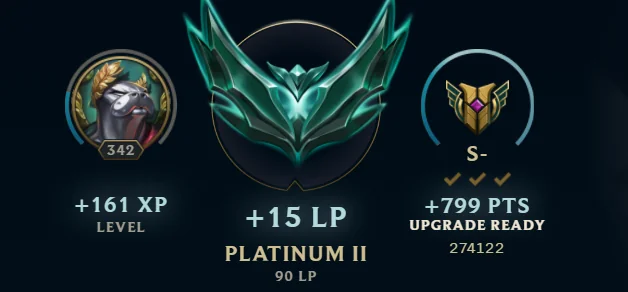
Credit: Reddit
This is the most common question many League players have. To understand the answer, our League of Legends ranks guide will help you understand the two numbers attached to your profile. While there are various tools that can help you with stats and builds, these numbers are integrated into the League system, and are not something you can that can affectively help you track your LP.
Visible Rank
This is what you see. Gold II, 45 LP. It is a badge of honor and a progression system designed to make you feel good about climbing. This is also the “official” rank your profile has. It’s easy for you to track and understand where you stand in the grand scheme of things. The visible rank is also something many other players will “judge” their teammates or opponents on. In the end, when the season is done, this is the emblem that will be presented on your profile.
Matchmaking Rating (MMR)
This is a hidden number that represents your actual skill. The system uses MMR to find fair matches. If you go on a lucky 10-game win streak, your Visible Rank might shoot up to Platinum, but your MMR might still lag behind in Gold because the system is not yet convinced you have truly improved. If you are to take anything out of our League of Legends ranks guide, it should be that the importance of MMR is much higher than the visible rank you see.
The rubber band effect
No League of Legends ranks guide would be complete without explaining the rubber band mechanics. Rubberbanding is essentially the systems way of pulling you towards your designed place in the rank distribution system if you go too much in one or the other direction.
- Positive State (Climbing): If your MMR is higher than your Rank (the game thinks you are a Smurf), the rubber band pulls your rank up. You gain huge LP (+28) and lose very little (-10).
- Negative State (Doomed): If your Rank is higher than your MMR (you are losing too much), the rubber band pulls your rank down. The system tries to force you back to where you belong by giving you +15 LP for a win and -25 LP for a loss.
The Fix: The only cure for “doomed” LP gains is to win consistently. You need to convince the algorithm that you belong at your current rank. To do so, you cannot force anything, you need to constantly provide similar results.
Placements and the start of the climb
When a new split starts, you do not keep your old rank. You are “soft reset.” This means you are pulled slightly closer to the average (Silver/Gold) while still respecting your past achievements.
As established in this League of Legends ranks guide, you must play 5 Placement Matches at the start of the split.
- Game 1: You are given a provisional starting rank. It will be significantly lower than where you ended the last split. Do not panic. This is normal.
- Games 2-5: During these games, you gain massive amounts of LP for wins and lose zero LP for losses. You can easily jump entire divisions in a single game during placements.
Once the 5 games are done, your rank is locked in, and standard LP losses apply.

Credit: League of Legends Wiki
Splits and rewards: The yearly grind
Gone are the days of a single, year-long marathon. The ranked year is now divided into three splits, keeping the stakes high and the meta fresh. This change was made to prevent the “mid-season burnout” where players would hit their goal in March and stop playing until November.
Moreover, every League of Legends ranks guide you run into will tell you that this decision from Riot Games is one of the better ones they made lately. It keeps things fresh and interesting for players, constantly pushing limits for improvement.
The Schedule:
- Split 1: Starts early January. Ends late April.
- Split 2: Starts late April. Ends late August.
- Split 3: Starts late August. Ends early January.
At the end of each split, you earn a Victorious Skin if you have accumulated enough Split Points (SP). You earn SP simply by playing games (more for a win, less for a loss).

Credit: League of Legends Universe Wiki
Pro Tip: Because there are three splits, there are three Victorious skins per year. If you want to collect them all, you cannot take a 6-month break. Check the LoLNow.gg tier lists at the start of each split because the meta shifts drastically with the mid-year gameplay updates.
League of Legends ranks guide on rank decay – The price of inactivity
For most players reading this League of Legends ranks guide, you can take a month off to play other games, and your rank will sit safely where you left it. However, if you reach the Apex Tiers, you are renting your spot rather than owning it. This is one of the main reason the rank distribution system in League is the way it is.
The system uses a “Banking” mechanic. Every game you play adds “days” to your bank. If your bank hits zero, you lose LP every single day until you play again or demote.
Here is the complete breakdown of how decay works:
| Rank Tier | Decay Active? | Banked Days per Game | Max Banked Days | LP Lost per Decay Day |
| Iron | No | N/A | N/A | 0 |
| Bronze | No | N/A | N/A | 0 |
| Silver | No | N/A | N/A | 0 |
| Gold | No | N/A | N/A | 0 |
| Platinum | No | N/A | N/A | 0 |
| Emerald | No | N/A | N/A | 0 |
| Diamond | Yes | 7 Days | 28 Days | 50 LP |
| Master | Yes | 1 Day | 14 Days | 75 LP |
| Grandmaster | Yes | 1 Day | 14 Days | 75 LP |
| Challenger | Yes | 1 Day | 14 Days | 75 LP |
Crucial Warning: In Master tier and above, you cannot just play one game a week. You need to play almost daily to maintain your bank. Also, keep in mind that dodging a lobby in Master+ counts as a loss of LP and does not bank a day.
Where are you in the Leagues rank distribution system?
The Foundational Tiers
The vast majority of the player base resides in the starting tiers.
- Iron (The Floor): This is the starting point for many, representing 10–15% of the total population. Approximately 41 million players are currently in this bracket.
- Bronze (The Beginners): One step up, this is the largest single group in the lower bracket. It contains 18–20% of all players, totaling roughly 47.5 million people who are learning the ropes.
The Average & Developing Tiers
This is where the bulk of the active, long-term player base competes.
- Silver (The Developing): These players are refining their mechanics. They make up another 18–20% of the distribution, with a population of about 23.5 million.
- Gold (The Average Veteran): This is generally considered the standard for an experienced casual player. It accounts for 20–22% of the base, or approximately 14.9 million players.
The High Tiers
Once you pass Gold, the competition becomes significantly tougher, and the player pool shrinks.
- Platinum (Above Average): These players have broken past the middle of the pack. They represent 15–18% of the total, with roughly 8.2 million players.
- Emerald (The Gatekeepers): This tier bridges the gap between casual and elite play. It contains 10–12% of the base, comprised of about 3.5 million players.
The Apex
The very top of the ladder is exclusive, holding only a tiny fraction of the total population.
- Diamond (The Elite): Only 2–3% of players reach this level. The count drops drastically here to just 81,000 players.
- Master, Grandmaster, Challenger (The Apex): This is the absolute peak of competition. Combined, these ranks make up less than 0.5% of the entire game, consisting of a tight-knit group of 94,900 players.
Demotion protection and shields
Riot Games understands that it feels terrible to finally reach Platinum IV only to lose one game and drop back to Gold I. To fix this, the system grants you a demotion shield.
When you promote to a new tier, you get a temporary buffer. You can lose several games at 0 LP without dropping. However, this shield is not infinite. But you don’t need an entire League of Legends ranks guide to understand that. All you need to know is that:
- Yellow Warning: If your MMR drops significantly below your rank while shielded, you will see a yellow exclamation mark in your profile. This means your shield is expiring.
- Red Warning: If you continue to lose, the icon turns red. This is your final warning.
- The Drop: Lose a game at 0 LP with a Red Warning, and you will be demoted to the previous tier (usually to 75 LP or 50 LP).
League of Legends ranks FAQs
Can I dodge games to save my MMR?
Yes and No. When you dodge a lobby (close the client during champion select), you lose LP (-5 for the first time, -15 for subsequent times) and you get a time penalty. However, your MMR stays exactly the same. Many high-Elo players strategically dodge games where their team composition looks terrible. They sacrifice a small amount of LP to protect their MMR from a guaranteed loss.
Why am I in “Smurf Queue”?
Riot tries to separate genuine new players from experienced players on new accounts. If the system detects you have high APM (actions per minute), high CS numbers, and high kill participation in your first few levels, it places you in matches with other “detected” skilled players. This is Smurf Queue. It results in very difficult, toxic, and volatile matches until your MMR stabilizes.
Can I skip a division?
Yes. If your MMR is significantly higher than your current rank, you can “double jump.” For example, you might win your promotional game in Silver IV and instantly jump to Silver II, completely skipping Silver III. This is the system’s way of rushing you to your correct skill bracket.
Does my performance (KDA/CS) affect my LP gain?
No. This is a common myth. The only thing that matters for LP gain is winning or losing. You can go 0/10/0 and win, and you will gain the same amount of LP as if you went 20/0/5. The system rewards winning the game, not padding your stats.
How to climb effectively
This League of Legends ranks guide has covered the mechanics, but the mindset is up to you. To summarize your path to the top:
Respect the splits, treat the year as three sprints. Do not burn out in February. Understand variance as you will have loss streaks. As long as you maintain a 51% winrate, you will climb mathematically over time. Bank your days; If you hit Diamond, build up that 28-day bank before going on vacation so you do not come home to an Emerald account. Dodge smart, having your Jungler be an autofilled Support main and your Mid laner being on a 10-game loss streak will rarely turn out well. Luckily, there are plenty of tools for you to check your teammates before the match starts.
The ladder is waiting. If you want to improve your knowledge about the game, from lore explanations, deeper guides, patch note updates, or even being up-to-date with the latest Clash schedule make sure you check LoLNow.gg for more.




0 Comments