

Riot Games’ new trading card game Riftbound is built around controlling Battlefields instead of reducing a life total. These Riftbound Rules are designed to be easy to learn, while still giving you real depth once you start timing spells, planning showdowns, and setting up multi-point turns.
This article breaks down the full Riftbound Rules you need for a complete game: setup, card types, resources, turn structure, movement, showdowns, combat, scoring, and all multiplayer formats.
What you need to play
Each player brings:
- Main Deck: Units, Spells, Gear
- Rune Deck: Rune cards used to pay costs
- 1 Battlefield: the location you contribute to the map
- 1 Champion Legend: always in play
- 1 Chosen Champion: starts available, becomes a unit when you play it
Riftbound supports:
- 1v1
- 3-player free-for-all
- 4-player free-for-all
- 2v2

Win condition in Riftbound: Conquer and hold
You score points by taking and keeping control of Battlefields.
- Conquer: You take control of a Battlefield by moving a unit there and ending up as the only player with units there.
- Hold: You start your turn still controlling a Battlefield you conquered earlier.
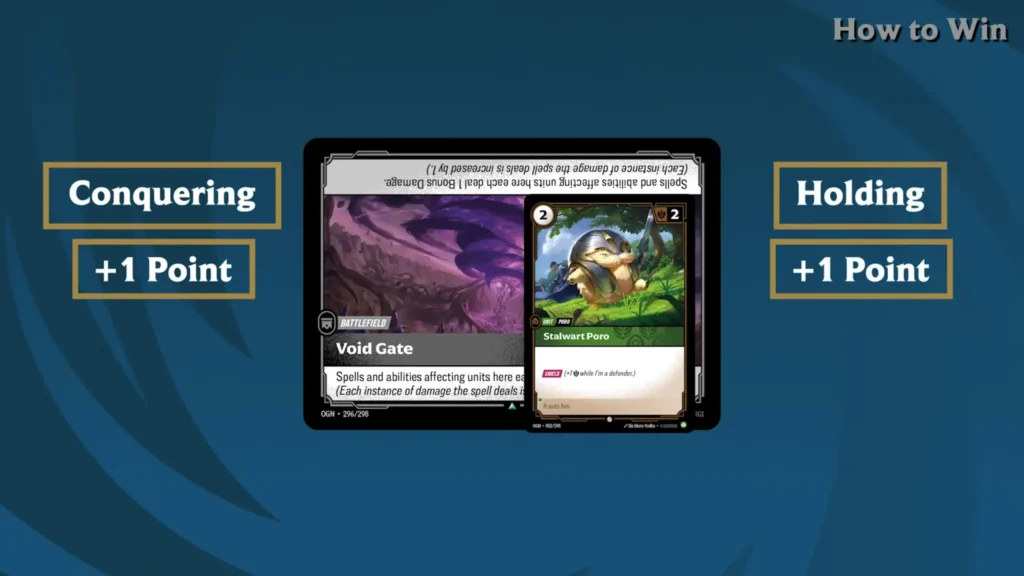
| Action | When it happens | What you get |
|---|---|---|
| Conquer a Battlefield | After your move and any showdown, if you control it | +1 point |
| Hold a Battlefield | At the start of your turn, if you still control it | +1 point |
Points needed to win
| Mode | Points to win |
|---|---|
| 1v1 Duel | 8 |
| 2v2 Team game | 11 |
| 3-player and 4-player free-for-all | 8 |
The final point rule (important Riftbound Rules)
If you would win by conquering a Battlefield for your last point, you cannot win by conquering only one Battlefield that turn.
- 1v1: If you are one point away and you conquer just one Battlefield, you do not score that point. Instead, you draw a card for the first Battlefield you conquer. You only win if you also score on the other Battlefield that same turn, usually by conquering it too, or by already scoring there that turn.
- 3-player Skirmish: To win by conquering a Battlefield, you must have already held or conquered the other two Battlefields that same turn.
This rule forces a real finishing push and is one of the most important Riftbound Rules to remember.
Card types in Riftbound
Your deck is built around a Champion, and that Champion shapes how your cards want to play.
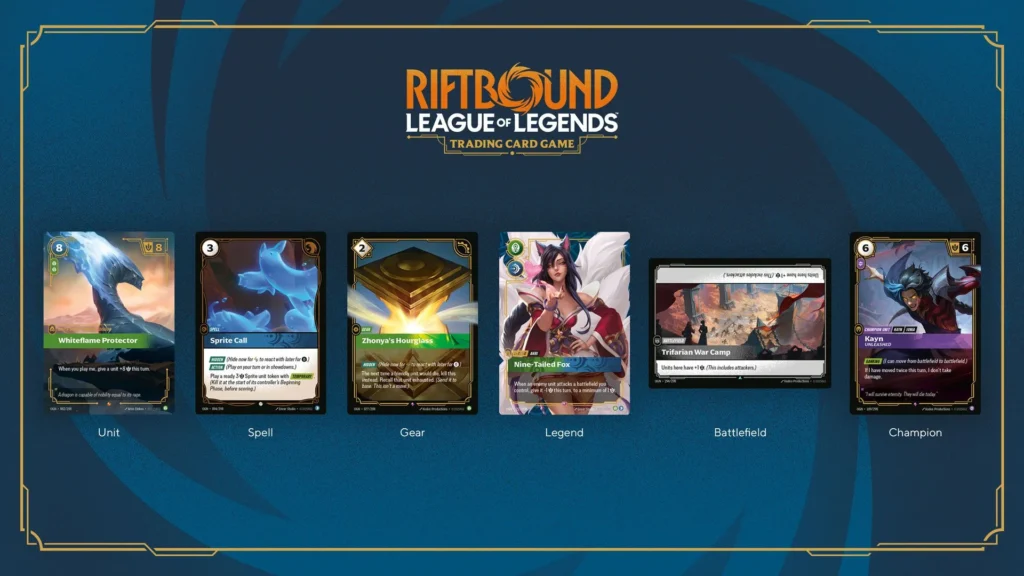
Source: Riot Games
| Card type | Where it starts | Where it goes | What it does |
|---|---|---|---|
| Champion Legend | On the board | Stays on board | Always active ability, defines your strategy and domains |
| Chosen Champion | Next to your Legend | Becomes a unit in your Base when played | A powerful unit built to match your Legend |
| Units | Main Deck | Base, then Battlefields | Conquer and hold Battlefields, fight in combat |
| Spells | Main Deck | Trash after use | One-time effects, often used in showdowns |
| Gear | Main Deck | Base | Repeatable utility effects, often exhaust to use |
| Runes | Rune Deck | Rune area | Pay Energy by exhausting, pay Power by recycling |
| Battlefields | Played during setup | Center | The objectives you fight over, each with unique effects |
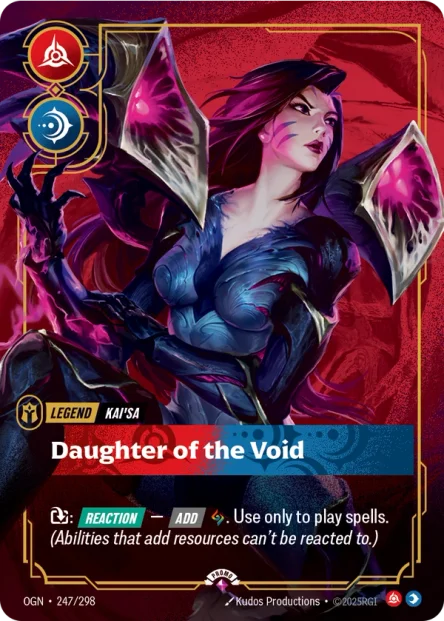
Champion Legend cards
Your Champion Legend begins on the board and is always active. It also shows your two Domains, the color pair your deck uses.
Domains matter because:
- They shape the theme of your cards.
- They determine what colors of runes you will have to pay Power costs.
Champion Legends push different styles of play, for example:
- Legends that reward conquering with multiple units usually want a wide board.
- Legends that trigger off expensive spells tend to play slower and spike harder later.

Units and Might
Units are how you actually win under the Riftbound Rules. You conquer, defend, and pressure Battlefields with them.
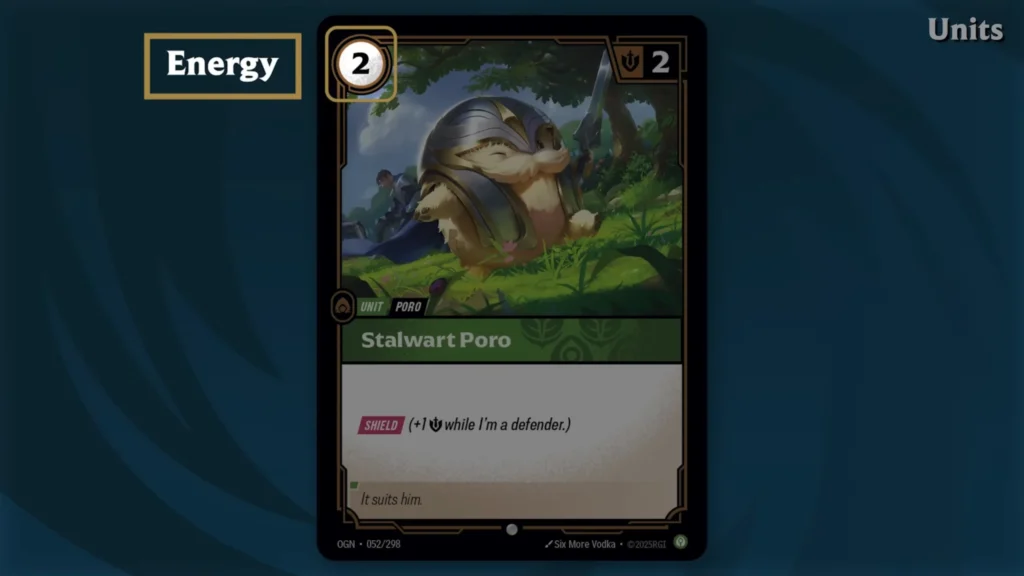
Unit anatomy
A unit card includes:
- Energy cost: number in the top left
- Power cost (sometimes): colored symbols under the energy cost
- Might: top right, used for both attack and defense
- Ability text: the rules text box
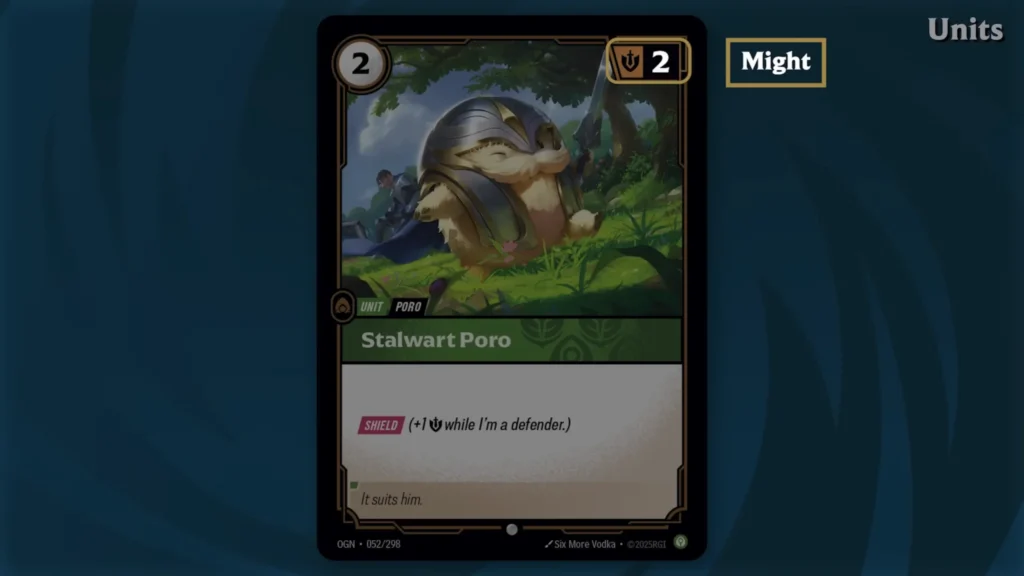
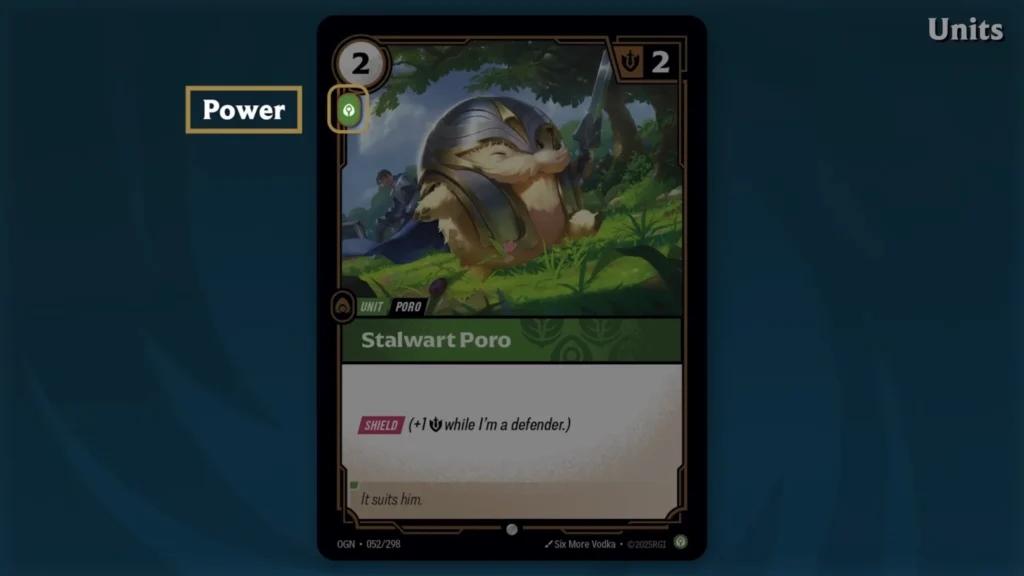
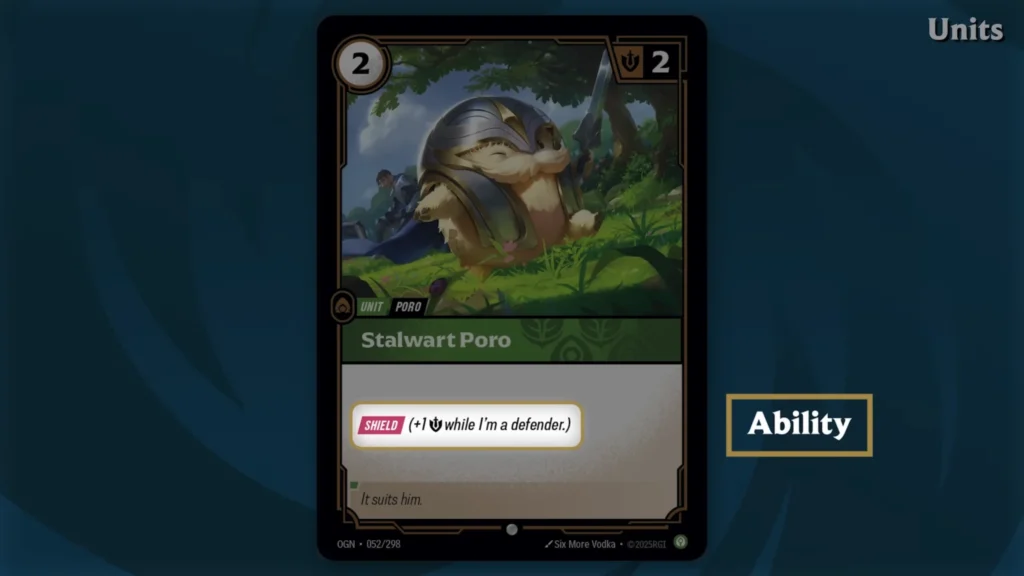
Source: Riftbound YouTube
Units enter exhausted
When you play a unit into your Base, it enters exhausted. That means it cannot move or use exhaust abilities until it readies on your next turn.

This is why good players often build a Base first, then move in waves.
Chosen Champion cards
Your Chosen Champion starts next to your Champion Legend, but is not in play yet. Think of it as an extra card you always have access to:
- You can play it as soon as you can pay its cost.
- When you play it, it enters your Base as a unit (usually exhausted like other units).
- It is designed to match your Legend’s strengths.

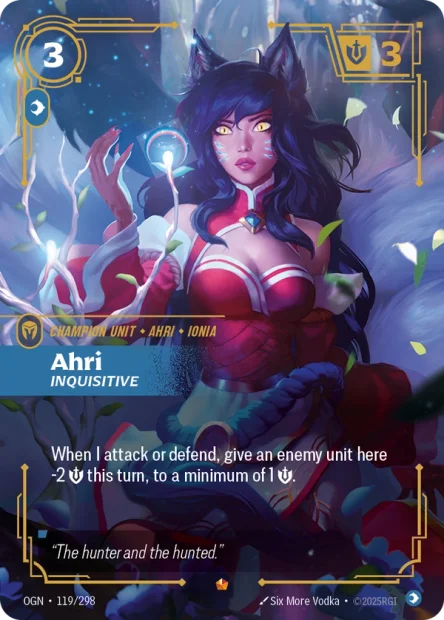
Some products let you choose between multiple Chosen Champion options at the start of the game.
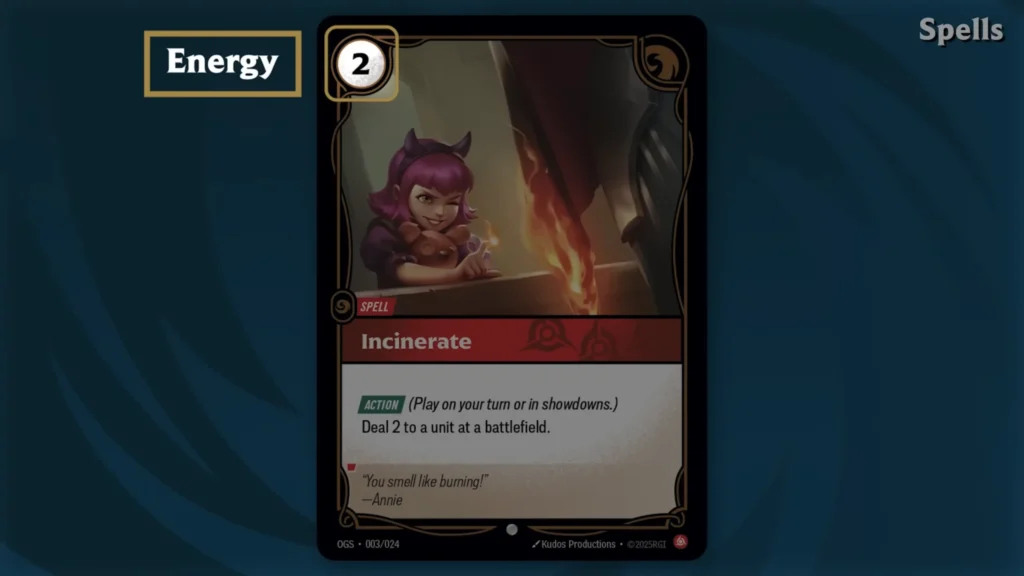
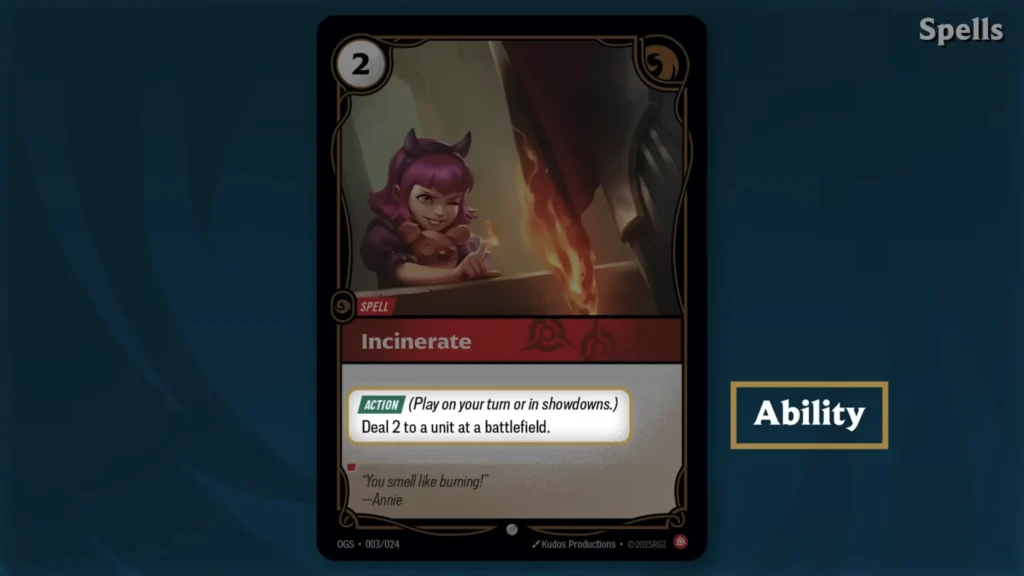
Spells
Spells are one-time effects. You pay the cost, resolve the effect, then put the spell into your Trash.
Spells matter in Riftbound because many of them can be used during Showdowns, including on your opponent’s turn, depending on their tags.
Gear
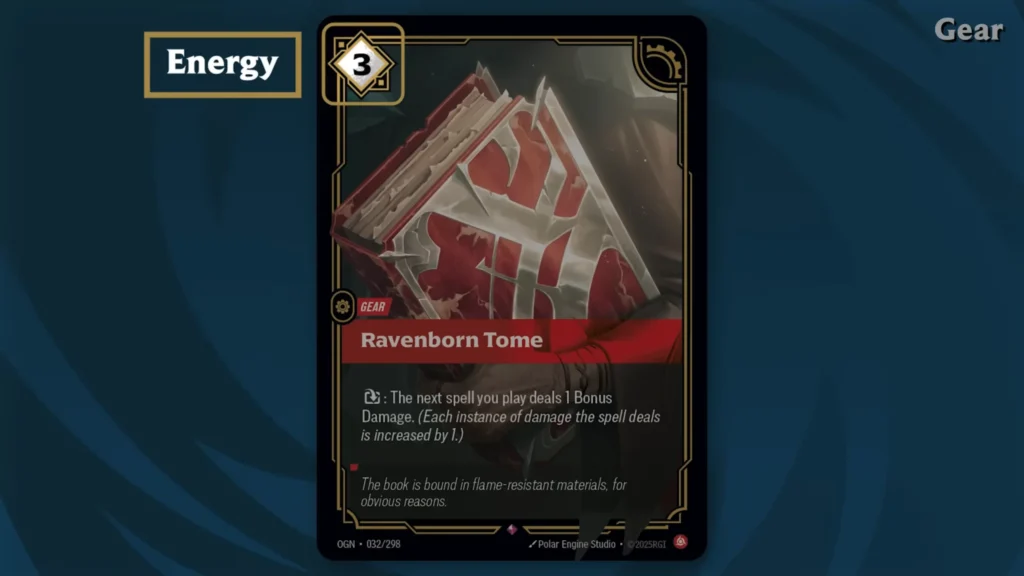
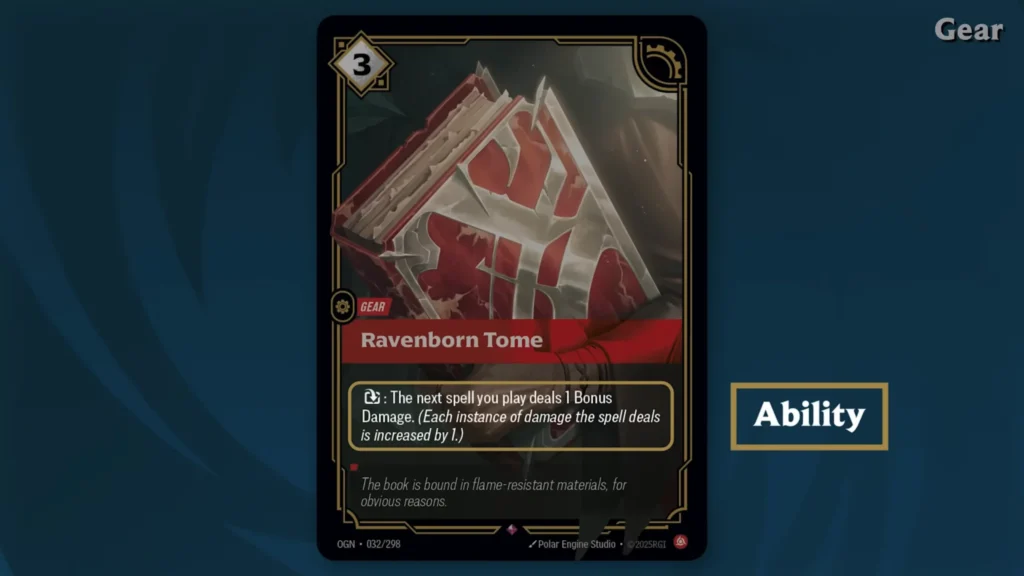
Gear stays in your Base and provides repeatable value.
Key points:
- Gear does not have Might.
- Gear typically enters ready, so you can often use it immediately.
- Example:
- Ravenborn Tome: When played, the next spell you play deal 1 bonus damage. (Each instance of damage the spell deals is increased by 1.)
The Rune system: Energy and Power
One of the defining Riftbound Rules is that you play with two decks: your Main Deck and your Rune Deck.
At the start of most turns you channel runes from your Rune Deck onto your board. These are your resources.
Energy vs Power
| Cost type | How it appears | How you pay it |
|---|---|---|
| Energy | A number | Exhaust that many runes, any color works |
| Power | Colored symbols | Recycle matching color runes to the bottom of your Rune Deck |
Exhausting runes
To pay Energy, you turn runes sideways. Exhausted runes cannot be used for Energy again until they ready.
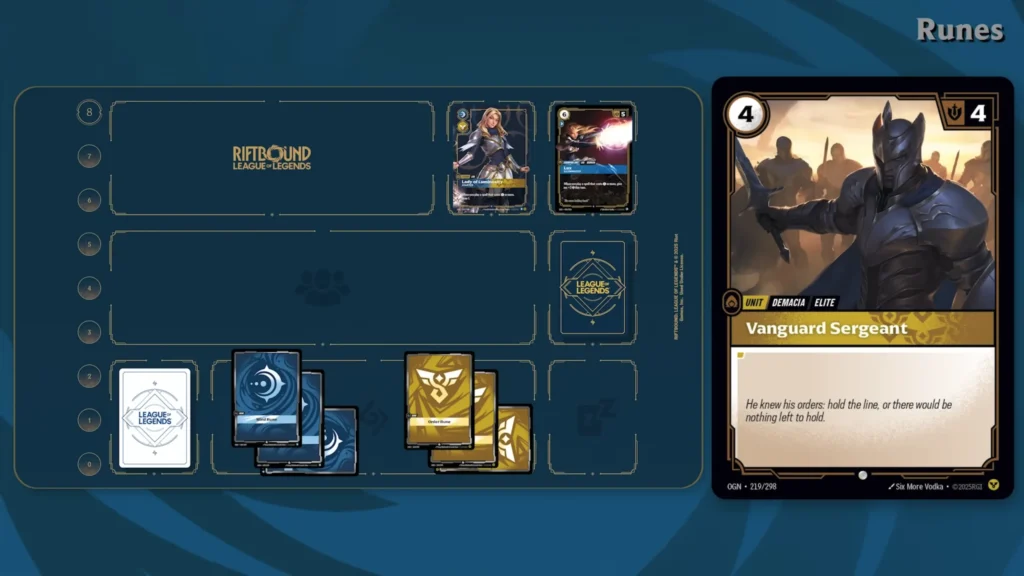
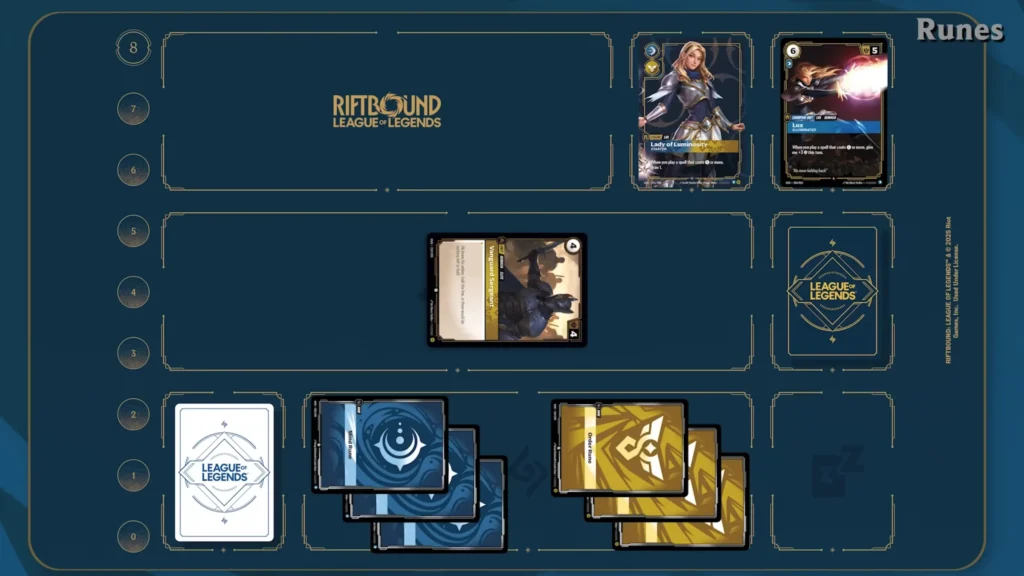
Recycling runes
To pay Power, you recycle runes by placing them on the bottom of your Rune Deck.
Two crucial Riftbound Rules here:
- You can recycle a rune even if it is exhausted.
- A rune can be exhausted for Energy and recycled for Power in the same card payment.
Some power symbols allow recycling a rune of any color.

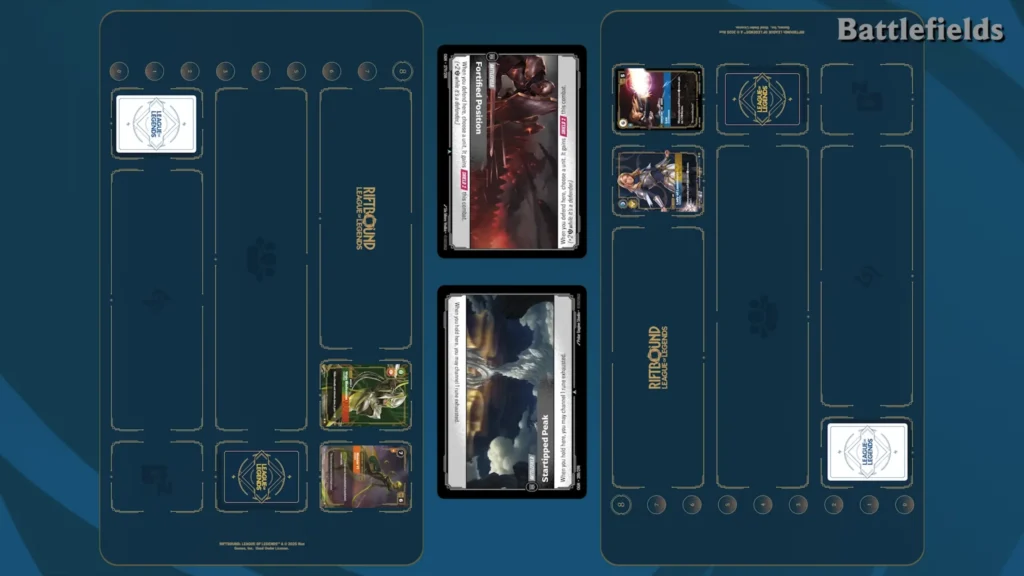
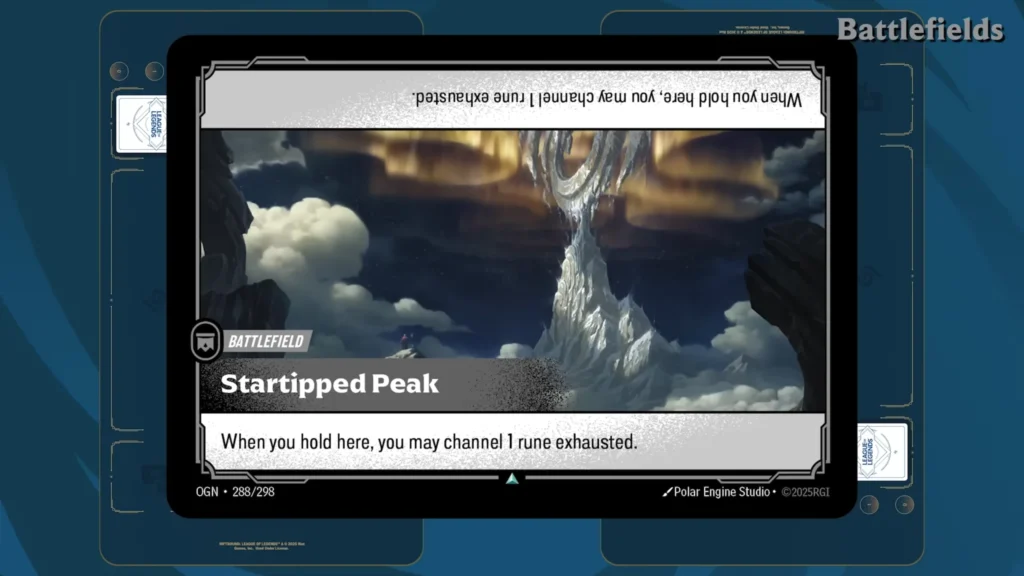
Battlefields
Battlefields are the objectives, and each Battlefield has its own effect that changes how fights play out. Some Battlefields reward holding with extra value, some make spells more deadly, and some shift how combats break.
You should always read the Battlefield text first before committing to a big fight there.
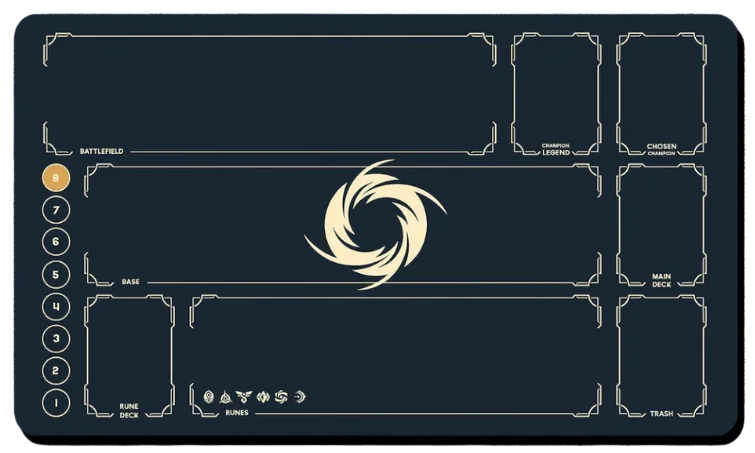
Setup: How to play Riftbound
Each player’s area includes:
- Champion Legend on the board
- Chosen Champion next to it
- Base area for units and gear
- Main Deck and Trash pile
- Rune Deck and Rune area for channeled runes
Battlefields are placed in the shared center.
Starting hand and mulligan
- Decide who goes first.
- Shuffle Main Deck and Rune Deck.
- Draw 4 cards from your Main Deck.
- Mulligan: You may recycle up to 2 cards from your hand to the bottom of your Main Deck, then draw that many replacements.
First turn rune bonus
In 1v1, the first player channels 2 runes, then the second player channels 3 runes on their first turn. After that, everyone channels 2 runes per turn unless a card says otherwise.
Key terms in Riftbound Rules
| Term | Meaning |
|---|---|
| Ready | Upright, can be used |
| Exhaust | Turned sideways, usually cannot be used again this turn |
| Move | Base to Battlefield, Battlefield to Base, sometimes Battlefield to Battlefield |
| Recycle | Put a card on the bottom of its deck |
| Card | Main Deck card, not a Rune or Battlefield |
| Tokens | Units created during play, any marker can represent them |
Turn structure: A, B, C, D
Every turn starts with the same four steps. These are core Riftbound Rules and you should memorize them.
| Step | Name | What you do |
|---|---|---|
| A | Awaken | Ready your exhausted cards |
| B | Beginning | Resolve start-of-turn effects, score for holding |
| C | Channel | Put runes from Rune Deck onto your board |
| D | Draw | Draw 1 card from Main Deck |
After that, you enter your Action phase, where you can do things in any order.
Action phase: what you can do
- Play units, gear, and spells
- Move units
- Use abilities
- Trigger showdowns and fight combats
Then end your turn and resolve any end-of-turn effects.
Conquering and holding, step by step
Conquering an empty Battlefield
- Move a ready unit from your Base to an unoccupied Battlefield, the unit exhausts.
- This creates an Open Showdown window.
- If the unit survives and you end up controlling the Battlefield, you conquer it and score a point.
Conquering an occupied Battlefield
- Move a ready unit to a Battlefield controlled by an opponent.
- This starts a Combat Showdown.
- Players can play spells and abilities using Action and Reaction tags.
- Combat resolves, and if only one player has units left there, they conquer and score.
Showdowns
A Showdown happens whenever a unit moves to a Battlefield the mover does not control.
| Showdown type | When it happens | What it means |
|---|---|---|
| Open Showdown | Unit moves to an empty Battlefield | Spells and abilities can stop the conquest |
| Combat Showdown | Unit moves into an enemy-held Battlefield | Spells and abilities happen before combat damage |
Actions, Reactions, and the chain
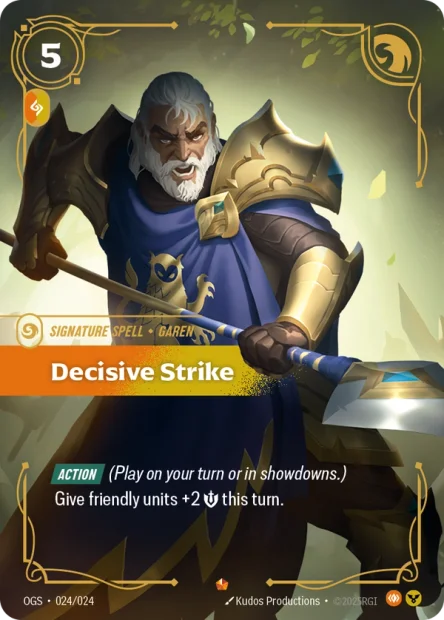
Many spells and some abilities are tagged:
- Action: playable during showdowns
- Reaction: playable in response during showdowns

The chain works like this:
- A player uses an Action spell or ability.
- The other player may respond with a Reaction.
- Reactions can be played on Reactions.
- This continues until no one adds more.
Timing rules that matter:
- Reactions can respond to spells or abilities.
- Reactions cannot respond directly to playing a unit or gear.
- Reactions can respond to abilities that trigger when those cards are played, if the ability timing allows.
Combat and Might
Combat happens after the showdown is finished.
Might is both attack and defense
Might represents:
- how much damage a unit deals in combat
- how much damage it can take before it dies
Damage assignment matters
When combat resolves:
- Each side totals the Might of their units at that Battlefield.
- Each player assigns their damage across the opposing units however they choose.
- A unit is destroyed if it takes damage equal to or greater than its Might, then it goes to the Trash.
Damage heals after combat
A key Riftbound Rules detail:
- Damage is healed at the end of combat and at the end of the turn.
- Damage does not permanently lower Might.
- If you want to kill a unit with spells, you often need to do it in the same turn before it heals.
Even if no spells were played, a showdown still happened, it was just a showdown where nobody added to the chain.
Multiplayer formats
Riftbound supports multiple formats, with a few rule changes.
Modes overview
| Mode | Players | Battlefields used | Special rules |
|---|---|---|---|
| Duel | 2 | 2 | Second player channels 3 runes on turn 1 |
| Match | 2 | 2 | Best of three, choose different battlefield each game |
| Skirmish | 3 | 3 | To win by conquering, you must also score on the other 2 battlefields that turn |
| War | 4 | 3 | First player skips first draw and removes their Battlefield, last player channels 3 on turn 1 |
| 2v2 (Magma Chamber) | 4 | 3 | Play to 11 points, first player skips first draw and removes their Battlefield, last player channels 3 on turn 1 |
Multiplayer showdowns
- In multiplayer, multiple players can participate in showdowns.
- Players can help whoever they want, even if they were invited in.
- Combat itself only ever involves units from two players, even if more players cast spells during the showdown.
2v2 rules you must know
In 2v2:
- Your team wins at 11 points
- Everyone can participate in showdowns, no invitation needed
- You and your ally cannot have units at the same Battlefield
- “Friendly” on cards includes your ally
- Your ally can play spells on your turn without waiting for a showdown
Quick checklist for your first game
If you want the smoothest first experience with these Riftbound Rules, follow this:
- Put your Champion Legend on the board, and your Chosen Champion next to it
- Shuffle Main Deck and Rune Deck
- Draw 4, mulligan up to 2
- Start each turn with A, B, C, D
- Build units in your Base for a turn or two, then move out to conquer
- Track points carefully, especially the final point rule
- Save a rune or two when you expect a showdown reaction war
Riftbound Rules – FAQ
How do you win in Riftbound?
Score points by conquering and holding Battlefields. Most modes are first to 8 points, while 2v2 is 11 points.
What is the difference between conquer and hold in Riftbound?
- Conquer: take control of a Battlefield, score +1.
- Hold: start your next turn still controlling it, score +1.
What is the “final point” rule in Riftbound?
If conquering would be your winning point, you usually can’t win by taking only one Battlefield that turn. In 1v1, the first conquest instead makes you draw a card, and you must also score on the other Battlefield that turn.
What does “score on the other 2 Battlefields” mean in Skirmish?
In 3-player Skirmish, to win by conquering you must also gain points from the other two Battlefields that same turn, usually by holding or conquering them earlier.
What are the key card types in Riftbound?
Champion Legend (always active), Chosen Champion (playable champion unit), Units, Spells (one-time), Gear (stays in base), Runes (resources), Battlefields (objectives).
How do runes work in Riftbound?
Pay Energy by exhausting any runes, pay Power by recycling matching-color runes to the bottom of your Rune deck. You can recycle an exhausted rune.
What is a Showdown in Riftbound Rules?
A spell-and-ability window that happens when a unit moves to a Battlefield you don’t control. It can be Open (empty field) or Combat (enemy units present).
Does damage reduce Might permanently in Riftbound Rules?
No. Damage heals after combat and at end of turn, units only die if they take damage equal to their Might.
Where can i find the Official Riftbound Rules
You can find the official Riftbound Rules straight from Riot here, including the complete keyword glossary, detailed rules, and any updates or clarifications that may not be covered in this guide.
If you want even more Riftbound content like this, you can find everything you need to know and the latest Riftbound updates here, including new product breakdowns, deck tips, and beginner-friendly explanations as the game evolves.




0 Comments